

What business owners, CFOs, and operations leaders need to know about the long tail of a claim, and what you can do about it.
A single workers' compensation claim. A liability lawsuit that settles in your favor. A property loss that insurance covered completely. From a business standpoint, those incidents are closed. From an insurance underwriter's standpoint, they may just be getting started.
The reality is that claims history follows your business for three to five years, sometimes longer. It influences how carriers price your coverage, whether preferred markets will quote your account, and how your experience modification factor behaves year over year. Understanding this dynamic is not about dwelling on the past. It is about building the kind of risk profile that earns you access to better terms, better carriers, and more competitive pricing going forward.
This article addresses the questions we hear most often from business leaders navigating the aftermath of losses, and explains how Winter-Dent's Prevent365 approach turns that history into a forward-looking strategy.
How Long Does a Claim Actually Hurt Us?
The standard window is three to five years, though the exact impact depends on the line of coverage and the nature of the loss.
For workers' compensation, your experience modification factor (the "mod") is calculated using three years of loss data, excluding the most recent policy year. A claim filed today will influence your mod for the next three renewal cycles. If losses are severe enough to move your mod above 1.0, the pricing consequences compound year after year until the loss ages out.
For general liability and commercial property, carriers typically review three to five years of loss runs during underwriting. A concentration of claims within a short window signals a pattern, even if each individual claim seems modest. Carriers are looking for trend lines, not isolated events.
The timeline shortens when businesses can demonstrate documented improvement. A company that had a rough two-year stretch but invested in loss control, updated its safety protocols, and has a clean record for the past 18 months tells a very different story than one that lost the same amount with no visible response.
What Underwriters Are Actually Looking For
- Frequency of claims relative to industry peers
- Severity compared to premium volume
- Evidence that root causes were identified and addressed
- Trend direction: improving or declining over time
- Broker's narrative and willingness to document the context
Is Frequency Worse Than Severity?
In most cases, yes. A business with ten small claims in a year raises more concern than a business with one large claim, even if the total dollar amounts are similar. Frequency suggests a systemic problem. It tells underwriters that something in your operations, your culture, or your processes is generating losses repeatedly.
This distinction is especially important in workers' compensation. The experience modification formula weights frequency more heavily than severity. Multiple small injuries drive a mod upward faster than a single costly event, because the formula is designed to identify whether a business is more or less injury-prone than its industry average.
That said, a single catastrophic loss can narrow your market access. If a claim is large enough, some carriers will non-renew the account regardless of prior history. This is why both dimensions matter, and why every claim should be managed with the same level of strategic attention.
| High Frequency / Low Severity | Low Frequency / High Severity | Carrier Perspective | |
| Example | 10 claims at $5K each | 1 claim at $500K | Both trigger underwriter scrutiny |
| Premium Impact | Moderate to significant increase | Potentially severe; market access may narrow | Loss trend concerns drive pricing |
| Experience Mod Impact | Higher impact — frequency drives mod sharply upward | Lower impact per dollar — severity is expected in the formula | Frequency is the bigger red flag for workers' comp |
| Carrier Signal | Suggests underlying safety or culture problems | May be isolated; context matters greatly | Documentation and narrative are critical |
| Recovery Timeline | 3–5 years; requires consistent loss-free history | 3–5 years; faster with documented risk improvements | Proactive strategy shortens the window |
| Best Response | Prevent365 root-cause analysis and OSHA discipline | Strong documentation, reserve management, return-to-work | Advisors who present you — not just submit you |
Real World Scenario: Nine Small Claims, One Very Large Problem*
A manufacturing company with 85 employees experienced nine workers' compensation claims over 18 months. None exceeded $12,000 individually, and each seemed isolated at the time. By the second renewal, their experience mod had climbed to 1.42, adding more than $60,000 to their annual premium. The underlying issue was not bad luck. It was an onboarding process that put new hires in high-risk tasks before they completed hands-on safety orientation. Once that root cause was identified and corrected, the company went 22 months claim-free. Their mod dropped to 1.18 at the following renewal and continued declining.
Should We Stop Filing Smaller Claims?
This is one of the most common questions we hear, and the answer is nuanced.
There are situations where absorbing a smaller loss out of pocket makes financial sense. If a claim is near your deductible anyway, if it involves a circumstance unlikely to repeat, and if filing it would tip your frequency metrics in the wrong direction, paying it directly may be the right call. This is often called "claims banking" and is a legitimate strategy for businesses with healthy reserves and a clear picture of their loss history.
However, this approach carries risks. Not filing a claim when you have coverage can create coverage gaps if a small incident turns into a larger problem down the road. Some injuries that seem minor initially develop complications. Some property damage that looks contained later reveals hidden structural issues. The decision to absorb a loss should always involve your risk advisor, not just your finance team.
One middle-ground option worth knowing: many carriers allow a report-only submission, where an incident is documented with the insurer but no payment is triggered. This preserves your ability to activate coverage if the situation develops, without immediately affecting your loss runs. Ask your advisor whether this option is available and appropriate before deciding to absorb a loss entirely.
The better long-term strategy is not to avoid filing claims but to prevent the incidents that generate them. Addressing the root causes of workplace injuries, near-misses, and operational vulnerabilities is what actually moves your risk profile. Winter-Dent's Prevent365 methodology is built around this principle: year-round engagement with your operations, not a conversation that only happens at renewal.
Questions to Ask Before Deciding Not to File
- Could this injury or damage develop into a larger liability?
- Does our deductible structure make absorption financially reasonable?
- Have we consulted with our advisor on the claims history implications?
- Do we understand how this would affect our mod or loss runs?
- Is there a documented root cause and corrective action in place?
- Has our advisor evaluated whether a report-only submission is the right approach?
How Does Our Experience Modification Factor Really Work?
Your experience modification factor, commonly called the "mod," is a multiplier applied to your workers' compensation premium. A mod of 1.0 means you are performing at the industry average. A mod above 1.0 means you are paying more than the base rate. A mod below 1.0 means you have earned a credit.
The calculation uses three years of your loss history compared to what would be expected for a business of your size and industry. It weights frequency (how often losses occur) more than severity (how large individual losses are). This is intentional: high frequency suggests a preventable problem, while a single large loss may be an anomaly.
The calculation also distinguishes between primary losses (the first portion of each claim, typically up to $17,500 or a similar threshold set by the rating bureau) and excess losses. Primary losses receive full weight in the mod calculation. Excess losses receive reduced weight. This means that managing the frequency of claims, not just their ultimate size, has the largest direct impact on your mod.
Mod Mechanics: What You Can Control
- Open reserves: Claims that remain open inflate your mod until they close. Proactive reserve management matters.
- Return-to-work programs: Getting injured employees back to modified duty reduces indemnity payments and total claim cost.
- Incident reporting speed: Faster reporting generally leads to better claim management and lower ultimate costs.
- Directing care to a preferred medical provider: Routing injured employees to an occupational doctor or designated provider at the time of injury typically results in faster, more consistent treatment and lower overall claim costs.
- Safety investments: Documented investments in loss prevention signal risk maturity to underwriters.
- Payroll accuracy: An inflated payroll basis increases your expected losses, which affects the mod baseline.
Will One Large Loss Cause Carriers to Leave?
It depends on the size of the loss relative to your premium, the carrier's appetite for your industry, and whether the loss looks like an isolated event or a symptom of something deeper.
A loss that represents a very high multiple of your annual premium will get underwriter attention. If it exceeds what the carrier considers manageable given your account size, it may trigger a non-renewal. This is not always negotiable, particularly with admitted carriers who have strict guidelines around loss ratios.
What often makes the difference is context. A carrier who receives a renewal application accompanied by a clear explanation of what caused the loss, what changed as a result, and why it is unlikely to recur is in a different position than a carrier who receives no information at all. This is where how you are represented to the market matters as much as your underlying numbers.
When a large loss does compromise your position with your current carrier, the conversation turns to alternative markets: surplus lines carriers, specialty markets, or captive arrangements that are structured to accommodate businesses with challenged histories. Understanding your options before you are in a crisis is the right time to have that conversation.
Real World Scenario: One Major Claim, and the Narrative That Saved the Account*
A regional logistics company suffered a $475,000 liability claim when a driver was involved in a serious accident. Their carrier non-renewed the account. Rather than scrambling at the last minute, their broker had already documented the company's investment in a driver monitoring program, updated hiring standards, and behind-the-wheel training completed six months before the incident. That documentation allowed the broker to approach three specialty markets with a credible narrative. The company secured coverage within their budget, and two years later returned to a preferred admitted carrier with clean intervening history and proof of program maturity.

When Should We Consider Alternative Markets?
Alternative markets, including surplus lines, specialty carriers, and group captives, become relevant in a few distinct situations.
The first is when your standard carrier non-renews you or offers terms that are unworkable. In this case, alternative markets are not optional. They are the path forward. The goal is to find a placement that keeps you covered and positioned to return to standard markets as your history improves.
The second situation is more strategic. Some businesses with moderate loss histories find that alternative market structures, particularly group captives or large deductible programs, actually deliver better long-term economics than traditional fully-insured placements. In a captive, you participate in underwriting profit when your losses are low. Over time, well-run captive programs reward businesses that invest in prevention.
The third situation is when your industry or risk profile simply does not fit standard carrier appetites, regardless of your claims record. Certain operations carry inherent complexity that surplus lines and specialty markets are designed to handle. A broker who only works with standard markets will not be able to advise you on this terrain.
Signs It May Be Time to Explore Alternative Markets
- Your current carrier has non-renewed or indicated they are re-evaluating your account
- You are receiving meaningful premium increases with no clear path to improvement
- Your mod has been above 1.0 for two or more consecutive years
- Your industry or operations are drawing adverse underwriter attention
- You have strong risk management practices and want to participate in underwriting savings
Can Proactive Changes Actually Offset Past Losses?
Yes. This is one of the most important and underutilized levers in commercial insurance.
Underwriters are not purely backward-looking. They are trying to assess future risk. A business that suffered losses two years ago but has since made measurable improvements to its operations is a different risk today than the numbers alone suggest. The challenge is presenting that story in a way that a carrier can evaluate and act on.
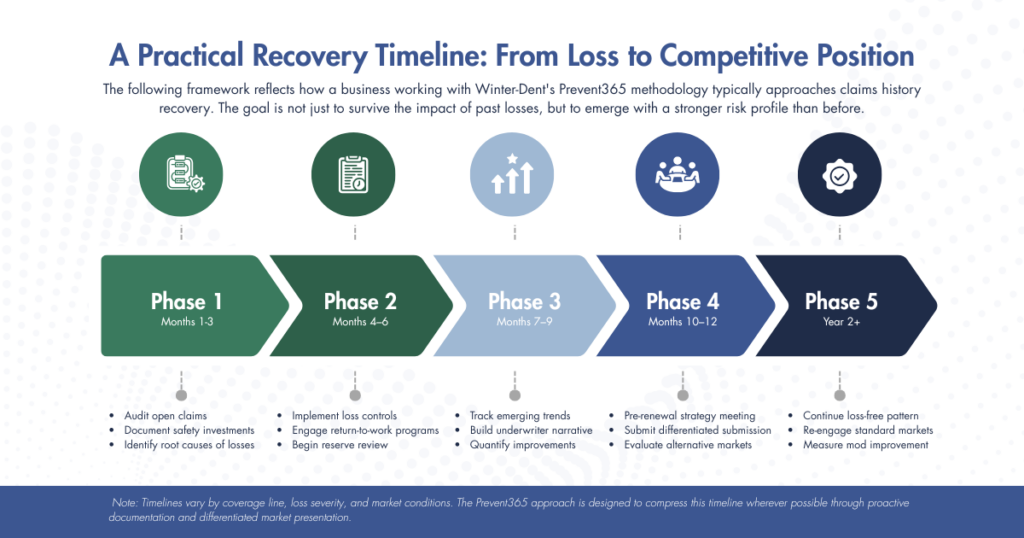
This is what the Prevent365 methodology is designed to do. Rather than waiting for renewal season to prepare a submission, Winter-Dent works with clients year-round to document safety investments, manage open claims, implement risk controls, and build the kind of loss prevention record that translates directly into underwriter confidence. By the time a renewal approaches, we are not asking carriers to take our word for it. We are presenting documented evidence.
The businesses that recover their insurance positioning fastest after a loss period are almost always the ones that treated risk management as an ongoing operational discipline, not an annual administrative task. The gap between a 1.35 mod and a 0.92 mod is often not years of waiting. It is the difference between passive renewal and active strategy.
What 'Documented Improvement' Looks Like to an Underwriter
- Written safety programs with proof of employee training
- Near-miss reporting logs that show a proactive culture
- Return-to-work program participation rates and outcomes
- Third-party safety audits or certifications
- Loss trend data showing frequency and severity declining
- Management accountability structures tied to safety performance
From 1.38 to 1.04 in Two Years: What Proactive Management Actually Looks Like*
A construction services firm came to Winter-Dent with a 1.38 mod and two years of unfavorable loss runs. Rather than waiting for bad years to age out, they worked through the Prevent365 process to close three open claims that had been sitting with inflated reserves, implement a formal return-to-work program, and document a supervisor accountability structure tied to incident reporting. At the next renewal, their mod had dropped to 1.19. The year after, it fell to 1.04. Their premium over that two-year period decreased by more than $80,000 compared to what projections had indicated if nothing had changed.
The Bottom Line
Claims history is one of the most consequential factors in commercial insurance pricing, carrier access, and long-term cost management. It affects your experience mod, your underwriting narrative, and your ability to compete for favorable terms across multiple lines of coverage.
But it is not fixed. Businesses that understand how the system works and engage with it strategically consistently outperform those that treat insurance as a passive, once-a-year transaction. The three-to-five-year window is not just a waiting period. It is a window of opportunity to build a risk profile that positions your business for better outcomes.
Winter-Dent does not simply place coverage. We help you understand your risk posture, manage it actively, and present it compellingly to the market. That is the difference between renewing and competing.
*The scenarios presented in this article are fictional representations created for illustrative purposes only. They are intended to demonstrate how proactive risk management strategies may influence insurance outcomes and do not represent actual clients or events. Individual results will vary based on a wide range of factors including business operations, loss history, market conditions, and carrier guidelines. Nothing in this article constitutes a guarantee of coverage, pricing, or outcome. Consult with a licensed insurance professional to evaluate your specific situation.