
Manufacturing operations face a complex risk landscape that extends far beyond the factory floor. From equipment breakdowns to evolving cyber threats, today's manufacturers must navigate exposures that can halt production, drain resources, and damage reputations.
Understanding these risks and implementing comprehensive protection strategies makes the difference between a manageable incident and a business-threatening crisis.
The Manufacturing Risk Landscape
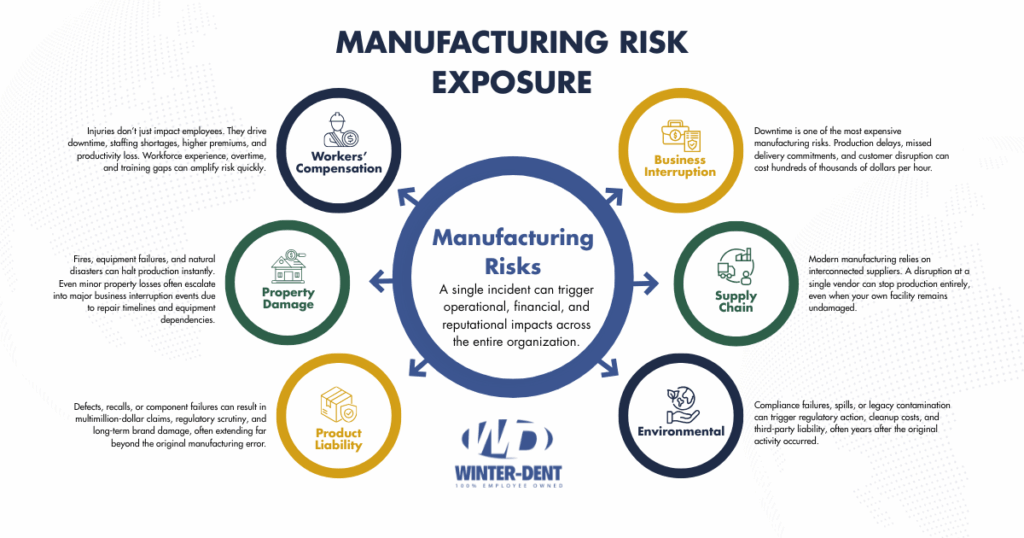
Manufacturing facilities face a unique convergence of physical, operational, and financial risks, in which a single incident can trigger cascading effects across operations, affecting production capacity, supply chain commitments, and customer relationships simultaneously.
Property Exposures
The threat to manufacturing property begins with fire risk. U.S. fire departments respond to an average of 37,000 fires at industrial or manufacturing properties annually, resulting in $1.2 billion in direct property damage, according to The National Fire Protection Association. Beyond fires, equipment failure accounts for 42% of unplanned downtime costs and one-third of all property-related losses.
The vulnerability extends deeper than simple statistics suggest. Modern manufacturing equipment, which incorporates sophisticated electronics and automation systems, increases both breakdown likelihood and repair costs when failures occur. Add natural disasters to this mix, and the interconnected nature of manufacturing operations means that even minor property damage can cascade into extended business interruption.
Workers' Compensation Challenges
The human cost of manufacturing operations presents its own set of challenges. The industry reported 355,800 injury and illness cases in 2023, representing a rate of 2.8 per 100 full-time equivalent workers. What makes these statistics particularly concerning is their relationship to workforce experience and staffing pressures.
The 2024 Travelers Injury Report revealed that 35% of workplace injuries occur during a worker’s first year. This finding directly correlates with today’s manufacturing reality. As companies struggle to fill positions, they increasingly hire less experienced workers or extend overtime for existing staff, both of which drive injury frequency higher. Injured manufacturing workers miss an average of 67 days, compounding the operational impact beyond the direct costs.
The most common injury causes include machine-related incidents, material handling injuries, repetitive motion disorders, and slip and fall accidents.
Product Liability and Business Interruption
Product liability represents one of the most financially significant exposures manufacturers face. Claims in this sector average over $7 million, a figure that reflects both the complexity of modern manufacturing and the extensive ripple effects of product failures.
Today’s supply chains add layers of complexity to liability determination. When manufacturers source components from multiple suppliers, determining defect responsibility becomes challenging. A single failed component can trigger recalls affecting thousands or millions of units, with costs that extend well beyond the physical recall itself to encompass brand damage, regulatory penalties, and lasting customer relationship impacts.
Business interruption amplifies these concerns. The Business Continuity Institute found that 56% of companies experience significant business interruption annually, with manufacturing downtime costing an average of $260,000 per hour. The modern just-in-time manufacturing model intensifies this risk, as manufacturers increasingly rely on single-source suppliers for critical components. When these suppliers experience disruptions, production can halt despite no direct property damage at the manufacturer’s own facility.
Environmental Risks
Environmental exposures stem from multiple aspects of manufacturing operations: raw material storage, production processes, waste disposal practices, and regulatory compliance requirements. Unlike many business risks that remain relatively static, the environmental regulatory landscape continues evolving, with federal, state, and local agencies imposing increasingly stringent requirements.
Non-compliance consequences can be severe, resulting in fines, cleanup orders, and third-party liability claims that escalate into seven-figure costs. Perhaps most challenging for established facilities, companies operating for decades may face cleanup obligations for past practices that were perfectly legal at the time but now violate current environmental standards.
Coverage Essentials
Protecting manufacturing operations requires specialized insurance that addresses both traditional exposures and industry-specific risks. Generic commercial packages, while simpler to obtain, rarely provide adequate protection for the complex exposure profile that manufacturers face.
Property Insurance
Effective property protection begins with replacement cost coverage rather than actual cash value. This distinction proves critical in the aftermath of a loss, ensuring manufacturers can fully rebuild without depreciation deductions reducing their recovery.
Equipment values demand particular scrutiny in this analysis. Specialized machinery often has limited market availability and long replacement lead times, making agreed value coverage essential to eliminate post-loss disputes about equipment worth when rapid replacement is critical to business continuity.
Equipment Breakdown Coverage
The gap in standard property insurance creates a critical need for equipment breakdown protection. Standard property policies exclude mechanical and electrical breakdowns, precisely the failure modes that account for 42% of unplanned downtime costs in manufacturing operations.
Equipment breakdown coverage fills this gap by protecting against sudden equipment failures, including electrical arcing, mechanical breakdown, and operator error. Given that manufacturing equipment costs increased 19% in recent years, this coverage provides essential protection extending beyond property repair to business income during repairs and expediting expenses for rush delivery or installation.
Workers' Compensation
Workers’ compensation typically represents one of the largest premium costs for manufacturers, making it a critical area for both adequate protection and cost management. Premiums are calculated based on payroll, classification codes, and the manufacturer’s experience modification factor, a number that directly reflects claims history.
The financial incentive for safety becomes clear in premium differentials. Manufacturers with no claims over three to five years enjoy substantially lower premiums than those with multiple claims. Carriers reinforce this incentive by offering additional discounts for formal safety plans, regular training programs, drug-free workplace initiatives, and early return-to-work programs.
General Liability and Products/Completed Operations
General liability insurance protects manufacturers from third-party bodily injury and property damage claims that can arise from various operational activities. Products and completed operations coverage extends this protection beyond the facility walls, responding to claims after products leave the manufacturer’s control.
The liability exposure varies significantly by industry segment and product type, with price increases common depending on loss experience. This variability makes effective risk management not just good practice, but economically essential for controlling insurance costs over time.
Cyber Risk
The convergence of operational technology and information technology has transformed cyber risk from an IT concern into an operational threat. The manufacturing sector experienced 838 ransomware incidents in 2025, representing a 61% increase from 520 incidents in 2024 and establishing manufacturing as the most targeted industry globally for ransomware attacks.
Modern manufacturing’s reliance on networked systems for inventory management, production control, quality monitoring, and supply chain coordination creates vulnerabilities that attackers actively exploit. The financial impact is staggering. The average total cost of a ransomware incident in manufacturing reached $8.7 million in 2024, with an average of 12 days of downtime during recovery.
Between 2022 and 2024, manufacturing ransomware incidents totaled approximately $284.6 million in ransom payments alone, not including the broader business interruption, recovery, and reputational costs. These figures demonstrate why cyber insurance has evolved from optional coverage to an essential component of manufacturing insurance programs.
Comprehensive cyber policies cover crisis response costs including forensic investigation and legal counsel, business interruption losses during system recovery, ransom payments where legal, notification costs when data is compromised, and third-party damages. Critically for manufacturers, policies should extend coverage to operational technology systems, not just traditional IT infrastructure, as production system attacks can be even more devastating than data breaches.
Umbrella and Excess Liability
Beyond primary liability limits, umbrella and excess liability coverage provides an additional layer of protection against catastrophic claims. Manufacturing operations face numerous scenarios where losses could exceed primary policy limits: major product recalls, environmental disasters, or significant third-party injuries.
This coverage becomes particularly valuable given the trend of increasing jury awards and settlement values in liability cases. The relatively modest premium for substantial additional coverage makes umbrella and excess liability a cost-effective component of comprehensive manufacturing insurance programs.
Professional Liability
Manufacturers providing engineering services, design work, or technical consulting need professional liability insurance to respond to claims of professional negligence, design errors, or inadequate advice. When product failures stem from design flaws rather than manufacturing defects, professional liability coverage becomes the primary policy.
Commercial Auto
Commercial auto insurance protects manufacturers from liability and physical damage involving company vehicles, delivery fleets, and mobile equipment. Coverage should extend to employee-owned vehicles used for business purposes through non-owned auto liability endorsements.
Beyond Standard Coverage: Manufacturing-Specific Exposures
While traditional commercial policies provide essential protection, manufacturers face specialized risks requiring targeted insurance solutions and strategic risk management.
Equipment Breakdown: The Hidden Cost Multiplier
Equipment failures create cascading financial impacts far exceeding repair costs—often by three to five times. During downtime, manufacturers continue paying fixed expenses while potentially facing delivery penalties, customer defections, and premium costs to expedite replacement equipment. This reality makes equipment breakdown coverage with adequate business income protection critical.
Supply Chain Vulnerability
Production doesn't halt only when your own equipment fails. Contingent business interruption coverage responds when direct physical damage at critical supplier or customer locations stops your operations. Identifying which suppliers could halt or severely impair your production informs both insurance purchasing and broader business continuity planning.
Contract Manufacturing Complexities
Manufacturers producing goods for other brands must ensure their insurance responds to product liability claims regardless of whose name appears on the label. This requires additional insured endorsements, contractual liability coverage, and products liability limits sufficient to protect both parties.
International Operations
Standard U.S. policies typically provide limited coverage outside the United States and Canada. Ocean marine coverage protects goods in transit, while foreign commercial general liability addresses exposures at foreign facilities. Political risk and trade credit insurance may be appropriate for significant foreign operations.
Product Recall Realities
Product contamination and recall insurance provides dedicated coverage for expenses that standard general liability policies exclude. These costs include retrieval, storage, investigation, repair or destruction, notification, public relations, and regulatory fines, expenses that can devastate an uninsured manufacturer.
Environmental Liability
Standard general liability policies contain absolute pollution exclusions. Manufacturers need separate environmental or pollution liability coverage responding to bodily injury, property damage, and cleanup costs from pollution conditions, whether sudden or gradual.
Prevention Strategies by Risk Type
Effective risk management transforms insurance from a reactive expense into a proactive investment. By systematically identifying hazards, implementing robust controls, and fostering a culture of safety, manufacturers reduce both claim frequency and insurance costs while protecting their most valuable assets - their people, facilities, and reputation.
Workers' Compensation: Protecting Your Workforce
Prevention begins on the factory floor with comprehensive machine guarding programs that prevent contact with moving parts and flying debris through properly designed guards and regular inspections. Before any maintenance begins, lockout/tagout procedures ensure equipment is fully shut down with energy sources isolated.
Beyond physical barriers, effective programs address how work gets done. Ergonomic job design analyzes and reduces repetitive motions, forceful exertions, and awkward postures that lead to cumulative trauma. PPE programs ensure employees properly use safety glasses, hearing protection, and other protective equipment appropriate to their specific tasks.
When injuries do occur, structured return-to-work programs with modified duty assignments help employees recover while maintaining their connection to the workplace and reducing indemnity costs.
Property Protection: Safeguarding Physical Assets
Fire represents the greatest property threat to most manufacturers, making fire protection systems essential. Quarterly inspections ensure sprinklers and alarms remain functional when needed most. Hot work permit programs control welding, cutting, and other spark-producing operations that create ignition risks.
Regular equipment maintenance schedules serve dual purposes—preventing costly breakdowns while reducing fire risk through proper electrical and mechanical upkeep. Emergency response planning should address evacuation procedures, equipment shutdown protocols, and coordination with first responders before an incident occurs.
Because no prevention program is perfect, business continuity planning identifies critical functions, pre-qualifies restoration contractors, and maintains off-site data backup to accelerate recovery when incidents do occur.
Liability and Quality Control: Preventing Product Issues
Product liability prevention starts with comprehensive quality control systems: incoming material inspection catches supplier defects before they enter production, in-process checks identify problems while correction remains economical, and final inspection provides the last defense before products reach customers.
Component testing and thorough documentation serve a dual purpose,verifying that products meet specifications while creating critical evidence for defending potential claims. This documentation becomes invaluable when questions arise months or years after manufacture.
Contractual risk transfer extends protection beyond your own operations by requiring suppliers to maintain adequate insurance and indemnify your company for defects in their components. Finally, product recall preparedness, including decision protocols, communication procedures, and pre-established logistics resources, ensures swift, effective response if quality issues do reach customers.
Winter-Dent: A Specialized Partnership Approach
We don't insure factories, we partner with manufacturers to build resilient operations. Our consultants conduct on-site risk assessments, identify loss drivers, and implement prevention measures that reduce both incident frequency and insurance costs.
See It in Action
The following hypothetical scenarios illustrate how strategic risk management partnerships can transform manufacturing operations and insurance outcomes.
Scenario: Metal Fabrication Manufacturer
Consider a metal fabrication manufacturer with 180 employees experiencing workers' compensation experience modification factors above 1.30, driving annual premiums approaching $900,000. Through comprehensive workplace safety assessments, the manufacturer could identify machine guarding improvements, enhance ergonomic practices in welding operations, and implement structured return-to-work programs with modified duty assignments.
Over three years, such initiatives could potentially reduce claims frequency by 60% and average claim severity by 40%. With the experience modification factor declining from 1.30 to 0.89, annual workers' compensation premiums could decrease to approximately $610,000, representing savings of nearly $300,000 annually while creating a safer workplace and improving employee morale.
Scenario: Food Processing Facility
Imagine a food processing facility facing severe property insurance rate increases following a fire causing $350,000 in property damage but $1.8 million in business interruption losses during a three-week shutdown. Through detailed property risk assessments, the facility could upgrade fire protection systems, implement comprehensive hot work permit programs, improve preventive maintenance protocols, and develop robust business continuity plans.
At renewal, such proactive measures could help negotiate coverage continuation at a 20% rate increase rather than the 60% increase initially projected. Over subsequent years, with no additional fire losses and effective business continuity planning preventing extended downtime during equipment breakdowns, property insurance rates could decline to 15% below pre-loss levels—demonstrating how strategic risk management creates sustainable cost savings.
Conclusion
Manufacturing insurance requires a sophisticated understanding of both unique exposures facing production operations and specialized coverages designed to address them. Effective programs combine comprehensive coverage with proactive risk management, recognizing that the goal extends beyond transferring risk to actually reducing loss frequency and severity.
As manufacturing continues evolving with increased automation, global supply chains, and digital integration, risk exposures will evolve as well. Staying ahead requires continuous evaluation of emerging risks and available insurance solutions, supported by brokers who understand manufacturing operations.
Winter-Dent specializes in manufacturing insurance and risk management solutions for food processors, metal fabricators, plastics manufacturers, and other production operations. Our consultants understand manufacturing risks from decades of experience identifying, evaluating, and mitigating exposures.
Ready to Evaluate Your Manufacturing Risk Profile?
Winter-Dent offers comprehensive Manufacturing Risk Assessments, including on-site operations reviews, detailed safety program evaluations, insurance coverage adequacy analysis, gap identification, and recommendations for risk management enhancements and optimal insurance program structure.
Contact us today to schedule your Manufacturing Risk Assessment and discover how a specialized partnership approach can reduce both your risk exposures and insurance costs while building a more resilient operation.