
Your premium isn't just a number. How you are positioned in the market determines what that signal says about your business.
When renewal comes around, most organizations do one of two things: they call their broker, or they wait for their broker to call them. Either way, the process feels reactive. A number arrives, it may be higher than last year, and the options seem limited to accepting it, shopping it, or hoping for a better market next cycle.
That framing is costing businesses money. Insurance pricing is not a fixed output of industry codes and loss history. It is a signal, and carriers are actively deciding what that signal says about your organization every time they evaluate your risk. The businesses that understand this, and act on it, consistently pay less and get better coverage than their peers.
Here is what underwriters are actually looking for, and how Winter-Dent's Prevent365 methodology is built to influence those factors before renewal ever arrives.
How Carriers Actually Set Your Premium
When an underwriter reviews your submission, they are not just reading an application. They are constructing a picture of your business: your operations, your exposures, your claims history, your safety culture, and the likelihood that you will incur future losses.
Today, carriers increasingly use AI-driven underwriting tools that score risks against large data sets. If your submission lacks context, your business gets averaged against every similar operation in your industry, including competitors with weaker safety records. That is a pricing problem, and most organizations do not know it is happening.
The factors underwriters weigh most heavily include:
- Claims frequency and severity, including whether clear patterns exist and whether root causes have been addressed
- Experience modification rate (EMR/mod), which directly measures your workers' compensation performance relative to your industry peers
- Safety program documentation that provides evidence formal training, hazard identification, and incident response protocols exist and are actively used
- Operational controls, including the specific practices, equipment, and procedures that reduce the probability of loss
- Financial stability and growth trajectory, since carriers prefer to write businesses that are well-managed and growing predictably
- Prior coverage history, because lapses, cancellations, and last-minute renewals all raise flags
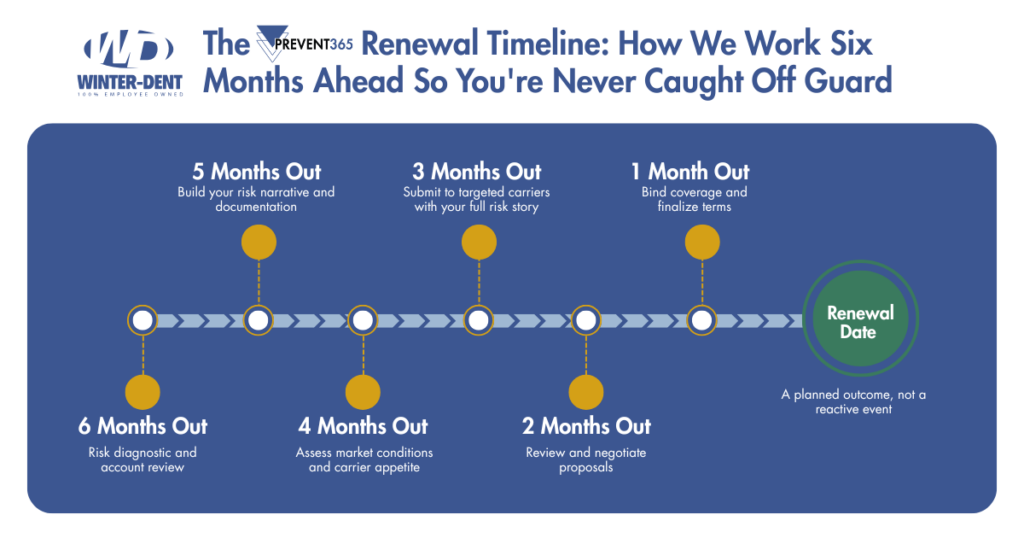
| The Prevent365 Principle Successful insurance outcomes are determined long before renewal. Winter-Dent begins renewal preparation six months in advance to ensure your risk profile is accurate, your story is documented, and carriers have every reason to compete for your business. |
Does Safety Training Documentation Actually Matter?
Yes, and the distinction between having a safety program and being able to demonstrate one is significant.
Underwriters cannot see inside your operations. What they can see is documentation. A business that submits well-organized safety training records, OSHA logs, incident reports with corrective actions, and return-to-work protocols is communicating something valuable: this is an organization that takes risk seriously.
That communication directly influences underwriting appetite and pricing flexibility. Without it, even companies with strong safety cultures get treated as average. Without documentation, average is all the data supports.
| Consider this:* A mid-size company had invested heavily in safety over three years: regular team safety meetings, a formal near-miss reporting system, and documented corrective actions after every incident. Their loss runs looked clean, but their broker submitted a standard application with no supporting narrative. The carrier priced them at mid-market. When they worked with a broker who packaged their safety documentation and presented it directly to underwriters, they came in lower at renewal with a broader policy form. The risk had not changed. The story had. |
Through Prevent365, Winter-Dent helps clients build and maintain the documentation infrastructure that turns operational excellence into underwriting advantage. Tools like AutomateSafety streamline training deployment and tracking across a workforce, while OSHAlogs keeps OSHA compliance records organized and audit-ready. These are not just internal compliance tools. They are the evidence package that differentiates your business in the market.
Will Better Claims Management Lower Your Premium?
Claims history is one of the most direct inputs into your pricing, and it is one of the areas where proactive management creates measurable financial return.
For workers' compensation specifically, your experience modification rate (EMR) is calculated from your claims history over a rolling three-year window. A high mod multiplies your base premium, sometimes significantly. But the mod is also something you can actively manage. When injuries do occur, fast response, appropriate medical care, and structured return-to-work programs reduce claim costs and duration. Over time, that claims performance is reflected in your mod and your pricing.
| Consider this:* A company with 80 employees had a mod of 1.18, meaning they were paying 18% above the industry base rate on their workers' comp premium. An analysis of their open claims revealed that three were sitting with inflated reserves because there was no active return-to-work program in place. Injured workers were staying out longer than necessary, and claim costs were climbing. After implementing a structured light-duty program and actively managing those open claims, their mod dropped to 0.96 over two renewal cycles. On a $200,000 annual workers' comp premium, that shift saved more than $40,000 per year. |
Winter-Dent's ModSure tool gives clients real visibility into the factors driving their workers' comp mod, including open claims, reserve levels, and projected impact on future premiums. LightDutyWorks supports return-to-work programs that keep injured employees productive and keep claims costs from escalating. These interventions compound: better claims outcomes today translate directly into lower costs at renewal.
Do Carriers Reward Proactive Risk Management?
The short answer is yes, but only if they know about it.
Carriers compete for preferred risks. When an organization demonstrates a sustained commitment to prevention, going beyond the absence of recent claims to active investment in reducing the probability of future losses, underwriters respond. They engage earlier, offer broader coverage options, and show more pricing flexibility.
The challenge is that most organizations do not present themselves this way. They submit applications, wait for quotes, and react to whatever pricing emerges. The proactive risk management work they have done, including safety training, operational controls, and claims management protocols, never reaches the underwriter in a meaningful way.
This is a core function of Winter-Dent's Prevent365 methodology. We do not just submit applications. We build a comprehensive risk profile that documents your strengths, contextualizes your history, and positions your organization as the kind of risk carriers want to write. That advocacy, communicating directly with underwriters and providing context behind the data, is what converts operational excellence into market advantage
What Makes a Business 'Attractive' to Insurers?
Underwriters are looking for businesses that reduce their uncertainty. Specifically, they want to see:
- Predictable loss patterns: frequency and severity that trend in the right direction, with documented explanations for any anomalies
- Operational transparency: clear descriptions of what you do, how you do it, and what controls are in place rather than a vague industry classification
- Management engagement: evidence that leadership is actively involved in risk management, not just delegating compliance
- Continuous improvement: documentation of changes made in response to incidents, near-misses, or identified hazards
- Financial health: stability and growth that indicate a well-run organization unlikely to cut corners on safety or maintenance
Most businesses have more of these qualities than their current broker is communicating. The gap between how an organization actually manages risk and how it is represented in the market is where unnecessary cost lives.
Can You Negotiate Insurance Pricing, or Is It Fixed?
Insurance pricing is not fixed. It is influenced by market conditions, carrier appetite, submission quality, and how effectively your broker advocates on your behalf.
The negotiation, however, does not happen at renewal. It happens in the months before, when underwriters are first developing their view of your risk. By the time quotes arrive, the underwriter has already formed a position. Changing it is difficult. Shaping it before it forms is where the leverage is.
| Consider this:* Two similarly sized businesses, comparable in operations and risk profile, came up for renewal at the same time in the same market. One engaged their broker 30 days before renewal, submitted a standard application, and received one competitive quote and one declination. The other had worked with their broker over the prior six months to classify exposures accurately, document their compliance programs, and identify the three carriers most likely to compete for their risk. They received four quotes and renewed with broader coverage at a lower rate than the prior year. Same market. Completely different outcomes, driven entirely by preparation and representation. |
Winter-Dent's approach of starting renewal preparation six months in advance, building your risk story, and engaging targeted carriers directly is designed to operate in that window. The goal is not a better quote. It is a better market position: one that generates competitive options, accurate pricing, and consistent renewals over time.
The Cost of Being Average in the Market
When a broker submits an application without differentiation, the carrier has no choice but to price your business against the average performer in your industry class. That average includes businesses with poor safety cultures, inconsistent management, and recurring claims. These are organizations you are not comparable to.
The result is that well-run organizations subsidize those that are not. They overpay for coverage they have earned the right to purchase at a better price.
What De-Averaging Actually Looks Like
De-averaging is not a marketing concept. It is a structured process, and it starts well before any carrier ever sees your name.
The first step is a thorough diagnostic of your current risk position: what your loss runs actually show, how your mod compares to industry benchmarks, where coverage gaps or misalignments exist, and what your current submission communicates to an underwriter who knows nothing about you.
The second step is building the risk narrative. This means documenting safety programs in a format underwriters recognize, capturing operational controls that reduce exposure, explaining loss history in context rather than leaving it to interpretation, and identifying the positive trends that a standard application would never surface.
The third step is targeted market placement. Rather than broadcasting your submission broadly, Prevent365 identifies the specific carriers whose appetite, industry focus, and risk tolerance align with your profile. Winter-Dent then engages those underwriters directly, presenting your risk story and advocating for terms that reflect your actual performance rather than your industry average.
The outcome is a market position that compounds over time. Each renewal builds on the last. Carriers develop familiarity with your account, your mod trends in the right direction, and your options in the market grow rather than narrow.
Prevent365 is built specifically to drive this process. We call it de-averaging your company: the systematic work of making sure your risk profile, your documentation, and your market representation all reflect the business you have actually built.
Ready to Stand Out to Underwriters?
A Prevent365 assessment starts with understanding your true risk profile: the exposures, the gaps, and the strengths that should be influencing your market position but are not. Contact Winter-Dent to learn how strategic placement and proactive risk management can lower your total cost of risk.
*The scenarios presented throughout this article are representative examples based on common client situations. They are intended to illustrate how risk positioning and broker representation affect real-world outcomes.