

What business leaders need to understand about experience modification factors, claim reserves, payroll, and the levers that actually move the needle on workers' comp cost.
This is one of the more frustrating conversations in commercial insurance. Your team worked hard on safety, claims went down, and then renewal arrived with a higher premium. It feels wrong, and in most cases nobody explained why.
The answer is almost never simple, but it is almost always explainable. Workers' compensation pricing is driven by a set of mechanics that operate on a delay, respond to factors beyond raw claim counts, and are frequently misunderstood even by businesses that have been buying coverage for decades. Once you understand how the system actually works, the premium increase usually makes sense, and more importantly, you can see what levers are available to address it.
Why Workers' Comp Premiums Can Increase Even When Claims Go Down
Workers' compensation premiums are influenced by several factors beyond the number of claims in a given year.
Common drivers include:
- Experience modification factor (e-mod) calculation window
- Payroll growth or wage increases
- Open claim reserves that remain on loss runs
- Classification code changes
- Overall insurance market pricing trends
Because the e-mod calculation reflects multiple prior policy years, improvements in safety and claims performance may take several years to appear in the premium.
How the Experience Modification Factor Actually Works
The experience modification factor, or e-mod, is the single most important number in your workers' comp program. It is a multiplier applied to your base premium that reflects your claims history relative to other businesses in your industry and size band. An e-mod of 1.0 means you are performing at the industry average. Below 1.0 is better than average. Above 1.0 means you are paying more than the baseline rate.
The e-mod is calculated by your state's rating bureau, in Missouri that is the National Council on Compensation Insurance (NCCI), using a formula that compares your actual losses to your expected losses based on your payroll and industry classification. It is not calculated by your insurance carrier, and your broker does not control it. What your advisor can control is how well they prepare you for it and whether your underlying data is accurate.
What goes into the formula
The e-mod formula has two components that are treated differently: primary losses and excess losses.
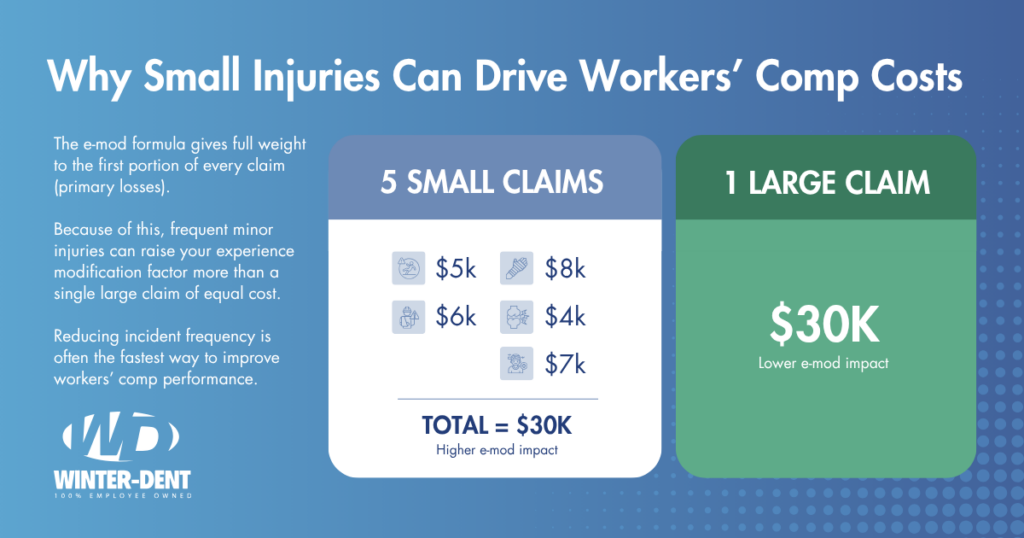
Primary losses are the first portion of each claim, typically the first $17,500 per occurrence under the current NCCI formula, though this threshold adjusts periodically. These losses are counted at full value and carry significant weight in the calculation. Excess losses, meaning the amount of each claim above the primary threshold, are discounted before being included. This means that claim frequency hurts you more than claim severity on a per-claim basis. In practical terms, preventing smaller injuries and minor incidents can have a greater impact on your e-mod than eliminating one large claim.
A business with five small claims will typically see a worse e-mod impact than a business with one large claim of equivalent total cost.
This is counterintuitive for most leaders. The instinct is to focus on the size of individual claims, but the formula is actually more sensitive to how often claims happen than how expensive any single claim is.
| Component | What it measures | How it affects your e-mod |
| Primary losses | First ~$17,500 of each claim | Counted at full value; high weight in formula; frequency-sensitive |
| Excess losses | Amount above the primary threshold per claim | Discounted before inclusion; large single claims hurt less than many small ones |
| Expected losses | What NCCI predicts based on your payroll and class code | The benchmark your actual losses are compared against |
| Ballast / weighting | A stabilizing factor based on employer size | Smaller employers have more volatility; larger employers have more credibility |
The Lag Time Between Claims and Rating Impact
This is usually the first piece of the puzzle when a business sees an unexpected premium increase after a good claims year. The e-mod calculation does not use your most recent policy year's claims. It uses the three prior years, excluding the most recent completed year.
In practical terms: if your policy renews on January 1, 2026, your e-mod reflects claims from policy years 2022, 2023, and 2024. Your 2025 claims do not appear in the calculation at all until the following year. If 2022 was a bad claims year and 2023, 2024, and 2025 were all clean, you still carry that 2022 experience until it rolls off after the 2026 renewal.
The lag works in both directions. If your claims spiked two years ago and have since improved, you are still paying for that spike now. If your claims improved this year, you will not see the full benefit until that year enters the rating window and the older, worse years drop off.
| Policy year | Included in 2026 e-mod? | Notes |
| 2025 (most recent completed) | No | Excluded from current calculation; enters next year's mod |
| 2024 | Yes | Carries full weight in current mod |
| 2023 | Yes | Carries full weight in current mod |
| 2022 | Yes | Carries full weight; rolls off after 2026 renewal |
| 2021 and earlier | No | Already rolled off; no longer affecting your rate |
The implication for leadership: the work you do on safety and claims management today is an investment in your 2027 and 2028 premiums, not your next renewal. That does not make the work less valuable. It just means expectations need to be calibrated accordingly.
How Payroll Changes Influence Your Premium
Workers' comp premium is calculated by applying a rate per $100 of payroll and then adjusting that base premium by your experience modification factor. If your payroll grew significantly, your premium will increase even if your e-mod stayed flat or improved slightly.
This catches growing businesses off guard regularly. A company that expanded its workforce, brought on a new division, or saw wages rise substantially can face a meaningful premium increase at renewal that has nothing to do with claims performance. It is simply a reflection of having more payroll exposed to the rating formula.
The reverse is also true, and it is a place where errors are common. If payroll is overstated at the start of the policy period, you are paying premium on exposure that does not exist. The end-of-year audit is supposed to correct this, but the audit process depends on the accuracy of the payroll data you provide and how it is classified.
Classification codes and why they matter
Every employee is assigned a workers' comp classification code that reflects the nature of their work. Rates vary dramatically by class code. A clerical worker carries a much lower rate than a roofing laborer or a manufacturing line employee. If employees are misclassified, either through error or because job duties have evolved, you may be paying rates that do not accurately reflect your actual workforce.
A thorough classification review at renewal, or ideally well before it, is one of the most straightforward ways to find premium dollars that should not be there. This is work that a proactive advisor should be doing as a matter of course, not something you should have to ask for.
Industry Rate Changes Also Affect Premium
Workers' compensation base rates are periodically adjusted by rating bureaus and insurance carriers based on statewide claim trends and market conditions.
Even if your company's claims performance improves, overall rate changes within your industry classification can still influence the premium.
These adjustments are typically smaller drivers than payroll or e-mod changes, but they can contribute to renewal differences.
What Role Do Reserves Play in Premium Calculations?
Open claim reserves are one of the most underappreciated drivers of e-mod movement, and they are also one of the areas where business owners have the least visibility without a good advisor.
When a workers' comp claim is filed, the insurance carrier establishes a reserve, which is an estimate of the total ultimate cost of that claim, including medical payments, indemnity, and expenses. That reserve figure, not just the dollars already paid, is what flows into your e-mod calculation. A claim that has cost $8,000 in payments but carries a $45,000 reserve is counted at $45,000 in the formula.
Reserves are set by claims adjusters based on early information about the injury, the anticipated treatment trajectory, and historical data for similar claims. They are not always accurate, and they tend to be conservative. An open claim with an inflated reserve can drag on your e-mod for years even if the actual settlement ends up being a fraction of the reserved amount.
What you can do about reserves
Reserves can be challenged. If a claim is reserved at a level that does not reflect the current medical prognosis or the realistic settlement range, your broker can work with the carrier's claims team to request a re-evaluation. This is not a routine part of the service most businesses receive, but it should be.
Active claim management, including regular communication with adjusters, return-to-work programs that reduce indemnity exposure, and early resolution of claims where appropriate, all contribute to keeping reserves at a level that reflects reality rather than worst-case assumptions.
| Reserve scenario | E-mod impact | What can help |
| Claim paid and closed below reserve | Reserve counted at full value until closure; e-mod improves when closed | Push for timely claim closure; document recovery progress |
| Open claim with inflated reserve | Full reserve included in e-mod calculation each year the claim is open | Request reserve re-evaluation with supporting medical documentation |
| Claim settled via lump sum | Reduces open reserve immediately upon closure | Early structured settlement can remove uncertainty from the formula |
| Return-to-work reduces indemnity | Lower total claim cost means lower primary loss count | Light duty programs directly reduce e-mod impact of each claim |
What Leadership Can Realistically Control Before Renewal
While the e-mod reflects past experience, the steps leadership takes today influence both how underwriters evaluate the account and how future e-mods develop.
The e-mod calculation is largely a trailing indicator. You cannot rewrite history. But there are meaningful actions that influence your trajectory and future mod calculations, and most businesses are not taking full advantage of them.
Start the renewal conversation earlier
Most workers' comp renewals are handled in the final 30 to 60 days before expiration. By that point, your e-mod is set, your loss runs are filed, and the underwriter's first impression of your account is already formed. A renewal process that starts 90 to 120 days out gives you time to prepare a narrative for the underwriter, address open claims, correct classification errors, and gather documentation that positions your account favorably.
Know your loss runs and dispute errors
Loss runs are the claims history report that underwriters use to evaluate your account. Errors in loss runs are more common than most businesses realize. Claims that belong to a prior owner, closed claims still showing as open, and reserve amounts that have not been updated all appear on loss runs and can negatively affect how underwriters and the rating bureau view your account. Reviewing loss runs annually and pushing for corrections is basic due diligence that a proactive advisor should be handling.
Invest in return-to-work infrastructure
Return-to-work programs reduce the indemnity portion of each claim, which directly reduces the primary loss amount that flows into your e-mod. They also reduce claim duration, which affects reserve levels. A formal light duty program, even a modest one, is one of the highest-return investments a mid-size employer can make in workers' comp cost management.
Document your safety improvements
Underwriters respond to evidence, not assertions. Documented safety training, OSHA recordable rate trends, near-miss reporting data, and formal safety program materials give underwriters a reason to price your account more favorably than the mod alone would suggest. This documentation also matters if you are pursuing alternative structures like captives or large deductible programs.
| Action | Impact on e-mod | Impact on underwriting |
| Return-to-work program | Reduces indemnity and primary losses per claim | Demonstrates proactive cost management |
| Reserve challenges on open claims | Can reduce losses included in current mod | Signals engaged employer; may improve carrier relationship |
| Classification code review | Can reduce payroll assigned to high-rate codes | Ensures premium reflects actual workforce accurately |
| Early renewal preparation | Allows time to address open items before mod is finalized | Gives underwriter a positive narrative before they quote |
| Documented safety programs | Reduces frequency over time; improves future mods | Differentiates your account from the average in your class |
When a Captive Structure Makes Sense
For businesses that have invested heavily in safety and claims management but still experience premium volatility in the traditional market, a captive insurance structure can be worth exploring. It is not the right answer for every employer, but for the right profile it can shift the dynamic from reacting to market pricing to controlling your own risk financing.
What a captive does
In a workers' comp captive, a group of employers with similar risk profiles pool their losses inside a shared insurance entity rather than transferring risk entirely to a commercial carrier. Each member pays into the captive based on their own loss experience, and the group shares in both the risk and any underwriting profit. If the group performs well, members receive a return of premium. If losses are higher than expected, members share in that shortfall.
The fundamental appeal is that it breaks the standard market pricing cycle. In the traditional market, a bad claims year raises your premium, which you pay to a carrier that retains the underwriting profit in good years. In a captive, you remain financially connected to your own performance. Good loss control translates directly to financial benefit, not just a marginal e-mod improvement.
Who is a candidate
A captive is not a fit for every employer. The profile that typically makes sense includes businesses with annual workers' comp premiums of $250,000 or more, a demonstrated commitment to safety and claims management, relatively stable and predictable payroll, and leadership willing to engage with a longer-term risk financing strategy rather than chasing the lowest renewal quote each year.
Businesses that are still working through significant claims frequency issues or that have not yet built the safety infrastructure to reduce losses are generally not good candidates yet. The captive structure rewards good performance. It does not rescue poor performance.
Group captives versus single-parent captives
For most mid-size employers, a group captive, where multiple businesses share the structure, is the practical entry point. Single-parent captives require significantly more capitalization and administrative infrastructure, and are typically reserved for very large employers or those with a diverse book of insurable risk across multiple lines.
Group captives in the workers' comp space are well established and have operated through multiple economic cycles. The key variables in evaluating one are the quality of the other members, the loss history and underwriting standards of the group, the captive manager's track record, and the structure's financial transparency.
How captive pricing compares to the standard market
In the short term, captive entry costs, including the initial collateral deposit and program fees, can make the first year more expensive than a standard market renewal. The financial case is built over three to five years, as underwriting profit is returned to members and loss control investments translate into measurable financial benefit. Businesses considering a captive should model this on a multi-year basis, not a single-year premium comparison.
| Factor | Standard market | Group captive |
| Premium pricing | Based on e-mod and class rates; carrier retains profit | Based on actual group performance; profit returned to members |
| Loss control incentive | Indirect; lower e-mod over time | Direct; your losses directly affect your cost |
| Premium volatility | Subject to market cycles and carrier underwriting decisions | More stable over time; driven by group performance |
| Entry requirements | Available to most employers | Typically $250K+ premium; underwriting standards apply |
| Time horizon | Annual renewal cycle | Multi-year commitment; financial benefit builds over time |
| Best fit | Businesses still developing loss control fundamentals | Businesses with strong safety culture and stable payroll |
How Winter-Dent Approaches Workers' Comp
Workers' compensation is one of the areas where the difference between a policy vendor and a proactive advisor shows up most clearly. The mechanics described in this article, e-mod structure, lag time, reserve management, classification accuracy, captive viability, are not complicated concepts, but they require someone actively managing them on your behalf throughout the year, not just at renewal.
The Prevent365 process at Winter-Dent is built around that kind of ongoing engagement. For workers' comp specifically, that includes a set of tools designed to give employers real visibility into the factors driving their costs.
ModSure
ModSure is Winter-Dent's e-mod analysis tool. It models the impact of individual claims on your current and projected mod, identifies claims that are disproportionately affecting your rating, and projects how your mod is likely to move as claims close and older years roll off. Rather than waiting for the rating bureau to publish your next mod, ModSure lets you see where you are headed and why.
AutomateSafety
AutomateSafety supports the documentation side of safety management, helping employers build and maintain the training records, inspection logs, and program documentation that matter to underwriters and that support a captive application if that path is being considered.
OSHAlogs
OSHAlogs simplifies OSHA recordkeeping, which matters both for compliance and for the loss data that feeds into underwriting evaluations. Accurate recordkeeping also provides the baseline data needed to measure whether safety investments are actually reducing injury rates.
LightDutyWorks
LightDutyWorks supports return-to-work programs by helping employers identify and document transitional duty assignments. Given how directly return-to-work activity affects indemnity costs and e-mod calculation, this is one of the most direct cost-management tools available to employers who are serious about controlling their workers' comp spend.
Questions Worth Asking at Your Next Renewal
If you are entering a workers' comp renewal and want to evaluate whether you are getting the service level your premium warrants, here are the specific questions to put to your advisor.
- Can you show me a detailed breakdown of my current e-mod calculation, including which claims are driving it and when they roll off?
- What is the status of each open claim on my loss runs, and are the reserves current and accurate?
- Are all of my employees classified correctly, and when was the last time we did a full classification review?
- How does my payroll growth over the past two years affect my projected premium, independent of the e-mod?
- What specific steps can we take in the next 90 days that would improve how underwriters view our account at renewal?
- Based on our premium size, loss history, and safety program, are we a viable candidate for a group captive, and have you modeled what that would look like over three years?
An advisor who can answer these questions with specifics, not generalities, is providing the level of service that a meaningful workers' comp spend deserves. If the answers are vague or the questions seem unfamiliar, that is useful information about the service relationship you are in.
FAQ: Workers' Compensation Premium Changes
Why did my workers' comp premium increase even though claims decreased?
Because workers' comp pricing reflects multiple prior policy years, improvements in claims may not appear in the premium immediately. Payroll growth, claim reserves, and classification changes can also affect pricing.
What is an experience modification factor (e-mod)?
An e-mod is a multiplier applied to workers' comp premium that compares your claims experience to similar employers in your industry.
How long does a workers' comp claim affect the e-mod?
Claims typically affect the e-mod for three policy years within the rating window, which excludes the most recent completed year.
Disclaimer: This article is for informational purposes only and does not constitute insurance advice. Workers' compensation rating formulas, thresholds, and program structures vary by state and insurer. Businesses should consult a licensed insurance professional to review their specific workers' compensation program. The examples, thresholds, and figures in this article are illustrative and based on general market conditions and NCCI guidelines as of 2025-2026. E-mod formulas, primary loss thresholds, and captive requirements vary by state and program. Consult a licensed insurance professional to evaluate your specific workers' compensation program.