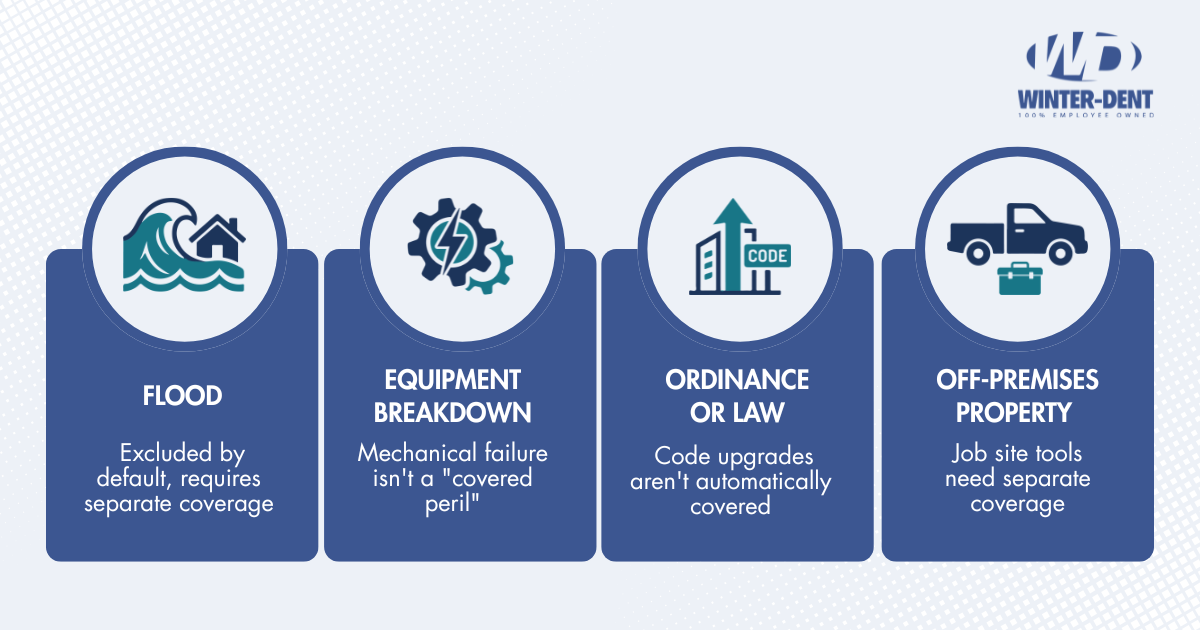
Most business owners assume commercial property insurance responds to any physical loss to their building or contents. It does not. Standard commercial property policies exclude specific categories of loss, including flood, mechanical breakdown, and code-required upgrades, and understanding these exclusions before a loss occurs is the only way to know whether your program actually protects what you think it does.
The Myth: "We're Covered If Something Happens to the Building"
This assumption is understandable. Business owners pay a premium, receive a policy, and reasonably conclude that the policy responds to loss or damage at their property. In practice, commercial property policies are built around a defined list of covered causes of loss, and anything outside that list is excluded by default, not by exception.
The gap between "insured" and "fully protected" is where a significant share of uncompensated commercial property losses occur, and it is rarely discovered until a claim is filed and partially or fully denied.
Quick Answer: Commercial Property PolicyStandard commercial property insurance covers specific, named or broadly defined causes of loss such as fire, wind, and theft, but excludes categories including flood, earth movement, and mechanical or electrical breakdown unless those coverages are specifically added. A business can carry an active property policy and still have no coverage for a loss that falls into one of these excluded categories. |
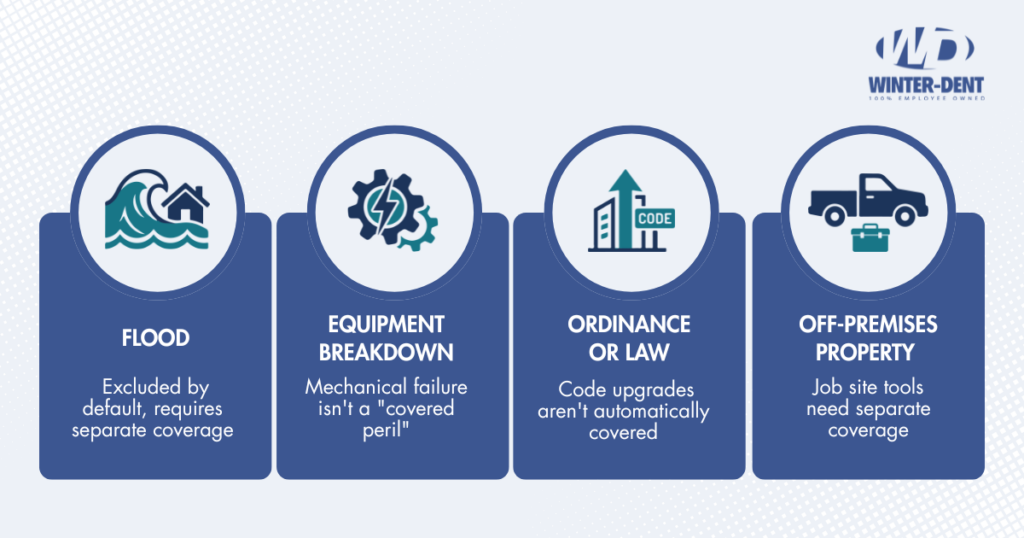
The Four Gaps Businesses Discover Too Late
Flood
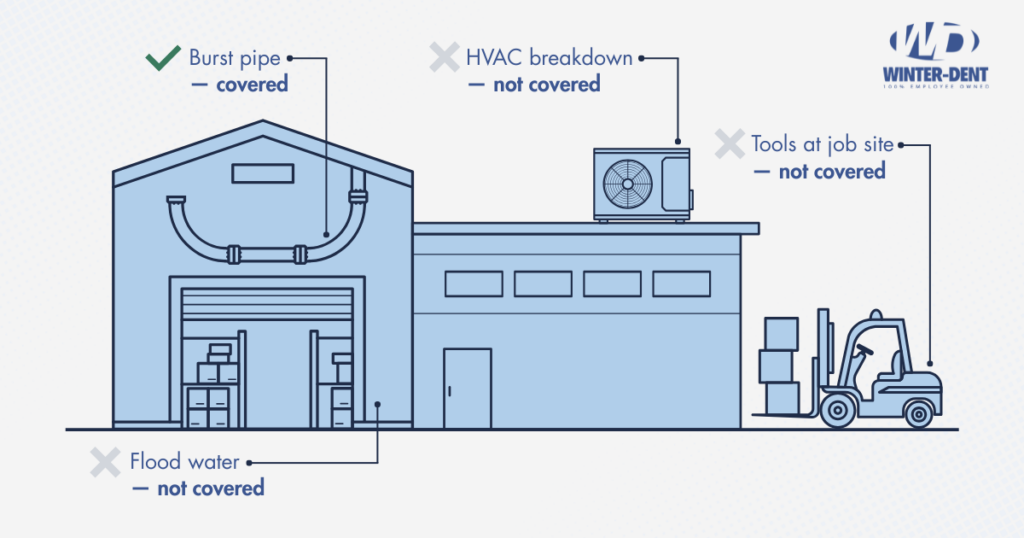
Standard commercial property policies exclude damage caused by flood, defined as surface water, storm surge, or the overflow of a body of water. This is frequently confused with water damage from an internal source, such as a burst pipe, which is typically covered. Flood coverage requires a separate policy, usually through the National Flood Insurance Program or a private flood carrier, and the exclusion applies regardless of whether the property sits in a mapped flood zone.
Equipment breakdown
Standard property forms exclude the sudden mechanical or electrical breakdown of equipment such as HVAC systems, boilers, and production machinery. A fire caused by an electrical failure may be covered under the base policy. The failure of the equipment itself, absent a covered peril like fire, typically is not, unless equipment breakdown coverage has been added.
Ordinance or law
When a covered loss requires rebuilding, local building codes may require upgrades the original structure did not have, from fire suppression systems to accessibility standards. Standard property coverage pays to restore what was lost, not to bring the rest of the structure up to current code. For older buildings, this gap can represent a substantial share of total rebuild cost.
Property away from premises
A standard commercial property policy generally covers contents at the address listed on the policy. Tools, equipment, and materials at a job site, in transit, or at a temporary location typically fall outside that coverage and require a separate inland marine policy. This gap is especially relevant for contractors and any business whose equipment regularly leaves the building.
What Most Businesses Assume vs. What Proactive Businesses Confirm
| Most Businesses Assume | Proactive Businesses Confirm |
|---|---|
| The property policy covers any physical damage to the building or contents | The policy's specific list of covered causes of loss, and what falls outside it |
| Flood and water damage are treated the same way | Whether their location has meaningful flood exposure requiring separate coverage |
| A rebuild after a loss restores the building as it was | Whether ordinance and law coverage is in place for code-required upgrades |
| Equipment failures are covered like any other property loss | Whether equipment breakdown coverage is added for HVAC, boilers, and machinery |
| Coverage follows the business wherever its equipment goes | Whether inland marine coverage protects tools and materials off-site |
The Strategic Insight Most Businesses Miss
Business owners tend to evaluate property insurance by asking "how much coverage do we have," measured in dollars. That is an incomplete question. The more consequential question is "what specific events does our coverage actually respond to," because a policy with a generous limit that excludes the peril that actually occurs pays nothing at all. Limit adequacy and peril adequacy are two different problems, and most property reviews only address the first one.
This is why a covered-peril audit matters as much as a valuation review. A business operating in an area with meaningful flood risk, running production equipment prone to mechanical failure, or regularly moving tools between job sites has specific, identifiable gaps that a generic renewal will not surface. Those gaps only get found through a deliberate review of what the policy actually excludes, matched against how the business actually operates.
Winter-Dent's Prevent365 methodology treats this as a structured, recurring discipline rather than a one-time policy check. Before each renewal, we review your covered perils, exclusions, and property-specific exposures such as flood zone status, equipment age, building age, and off-premises property, so the gaps get identified in a planning conversation rather than a denied claim.
Talk to a Winter-Dent advisor about reviewing your current policy's specific exclusions against how your business actually operates. Most owners are surprised by what they find.
What are the most common gaps in a commercial property insurance policy?The most common gaps are flood damage, mechanical or electrical equipment breakdown, code-required upgrades during a rebuild (ordinance or law coverage), and property located away from the insured premises. All four require separate coverage or specific endorsements and are excluded from a standard commercial property policy by default. |
See How This Fits Into a Complete Property Program
Understanding your exclusions is the first step. Learn how a properly structured commercial property insurance program addresses valuation accuracy, covered perils, and business interruption together, and see how Winter-Dent's Prevent365 approach reviews these gaps before each renewal.
Frequently Asked Questions
Does my commercial property policy cover water damage?
It depends on the source. Water damage from an internal source, such as a burst pipe or failed appliance, is typically covered under a standard commercial property policy. Water damage from flooding, defined as surface water, storm surge, or an overflowing body of water, is excluded and requires separate flood coverage. Sewer and drain backup is also commonly excluded unless specifically added by endorsement.
How do I know if equipment breakdown coverage applies to my business?
Equipment breakdown coverage is relevant for any business relying on HVAC systems, boilers, production machinery, refrigeration equipment, or computer systems whose failure would disrupt operations or cause significant cost. Manufacturers, restaurants, healthcare facilities, and any business with mechanical infrastructure critical to daily operations should confirm this coverage is in place, since standard property forms exclude mechanical breakdown by default.
What is ordinance or law coverage and does every business need it?
Ordinance or law coverage pays the additional cost of bringing a rebuilt structure up to current building codes after a covered loss. It is most relevant for older buildings, where code requirements have changed significantly since original construction. Newer buildings already built to current code carry less exposure here, but any business in an older structure should confirm whether this coverage is included or excluded.
If our equipment is stored at a job site instead of our building, is it covered?
Not under a standard commercial property policy, which typically covers contents only at the address listed on the policy. Equipment, tools, and materials at job sites, in transit, or at temporary locations require a separate inland marine policy. This is a common and consequential gap for contractors and any business that regularly moves equipment off-premises.
Can I find out whether my specific location has meaningful flood risk?
Yes. Flood risk for a specific address can be checked using FEMA flood maps, which show whether a property sits in a mapped flood zone. However, flood losses occur outside mapped high-risk zones more often than most business owners expect, so flood zone status is a starting point for the conversation, not the final word on whether coverage is worth carrying.