

Your loss run report is probably the most consequential document in your insurance program, and most business owners never read past the total at the bottom.
That total doesn't determine your policy price, though. The details underneath it do, and since nobody has looked at them in a while, there's a reasonable chance a few of them are wrong. So it's worth understanding what's actually on the report before your next renewal, starting with what the thing is.
What Is a Loss Run Report?
A loss run report is a carrier-generated history of every claim filed under your policy, typically covering the past three to five years. It lists each claim's date, description, status, amount paid, and amount still reserved. Carriers use it to price your renewal and to decide whether they want your business at all.
The easiest way to think about it is as your business's credit report for insurance. You didn't write it, you rarely see it, and it follows you for three to five years to every carrier that quotes you. Which is why knowing how to read it matters more than it might seem.
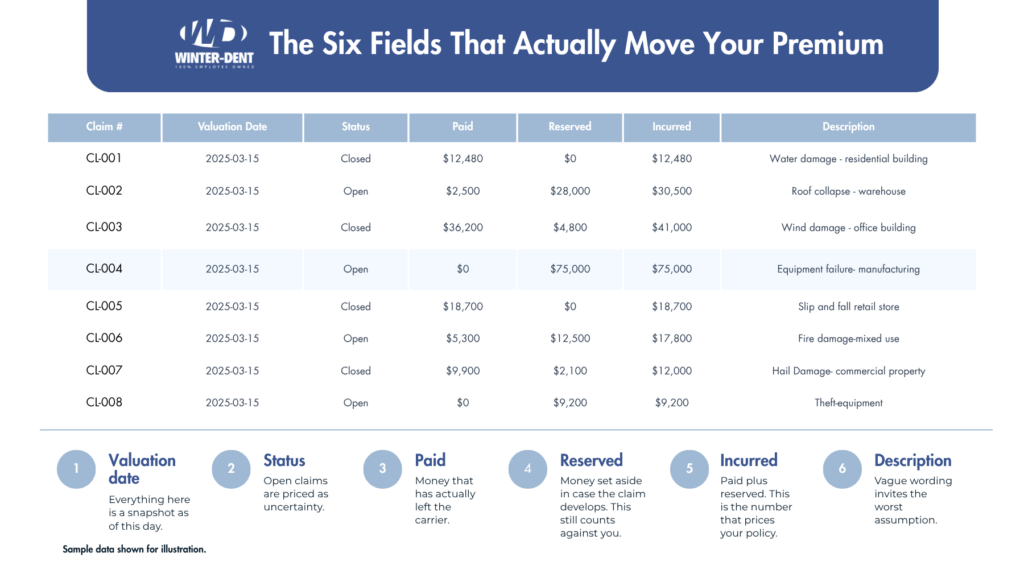
The Six Fields That Actually Move Your Premium
A loss run usually arrives looking like a spreadsheet with twenty columns, which is part of why people skip straight to the total. But only six of those columns are doing real work.
Valuation date
Start here, because everything else on the report depends on it. The valuation date is when the report was pulled, and every figure on it is a snapshot as of that day. So a loss run valued in March but used in a September renewal is six months stale, which means any claim that closed in the meantime is still being priced as though it were open.
Claim status
Open or closed, and the distinction matters because carriers price uncertainty conservatively. An open claim carries the possibility of getting worse, so it gets treated accordingly. Worth knowing, though, that a claim sitting open for three years with no activity usually isn't evidence of an expensive loss. More often it just means an adjuster hasn't gotten around to closing the file.
Paid versus reserved
This is the pair that explains most of what confuses people about their premium. Paid is money that has already left the carrier, while reserved is money the carrier is holding in case the claim develops further. Add them together and you get your incurred loss, which is the number that actually gets priced.
If you take one thing from this article, make it that one: you're priced on money the carrier is holding, not money it has spent.
Incurred total
Which is simply paid plus reserved. So a claim showing $2,000 paid and $48,000 reserved is being underwritten as a $50,000 claim, even though the file may eventually close out at $6,000.
Claim description
A single line of narrative, and it carries more weight than it looks like it should. This is where a strain becomes a "back injury" and a parking lot fender bender becomes a "vehicle accident with injury." Because when the description is vague, an underwriter fills in the blank themselves, and they rarely fill it in generously.
Claim count by policy year
Your frequency, meaning how many claims, how often, and whether the trend is moving in the right direction. That last field turns out to matter more than most owners expect, which is worth coming back to.
Why Open Reserves Cost More Than Closed Claims
Of those six fields, reserves are where the most money hides, so they deserve a closer look.
Direct answer: An open reserve is a carrier's estimate of what a claim might ultimately cost, and it counts against you at full value until the claim closes. A $40,000 reserve on a claim that settles for $5,000 inflates your loss history by $35,000 for as long as the file stays open. Reserves are estimates, and estimates can be challenged.
Here's the part that surprises people. Reserves get set early, often within days of the incident, by an adjuster working with very little information. They're meant to be conservative, since the carrier would rather over-reserve than under-reserve. What they're not meant to be is permanent, and yet that's exactly what they become when nobody goes back and revisits them.
Which is the most common reason a workers' compensation premium can go up even when claims go down. When reserves go unreviewed, three things tend to happen together:
- Your incurred losses look worse than your actual loss experience
- Your experience modification rate stays inflated for the full three-year rating period
- Carriers that might otherwise compete for your business quietly decline to quote
The fix itself isn't complicated. It's a conversation with the adjuster, backed by documentation, asking whether the reserve still reflects where the claim is likely to land. What makes it hard is that almost nobody has that conversation, because almost nobody is looking at the report between renewals.
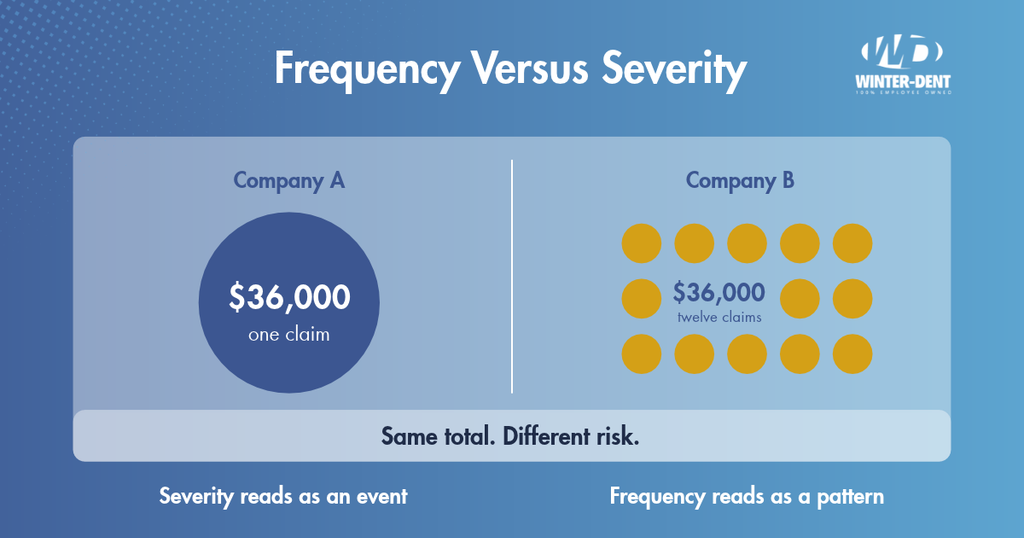
Frequency Versus Severity, and Which One Underwriters Punish
Reserves explain how a claim gets priced. The pattern of your claims explains how your company gets priced, and on that question most business owners guess wrong. They assume the big claim is the problem, while carriers usually see it the other way around.
Severity is one large loss, and it reads as bad luck. A single catastrophic claim in an otherwise clean five years is often forgiven, particularly if you can show what changed afterward. The industry has been moving deliberately in that direction, too. When NCCI revised its experience rating plan, one stated goal was producing modifications less sensitive to large outlier claims without sacrificing predictive accuracy.
Frequency is many small losses, and it reads as a management problem instead. Eleven $3,000 claims and one $33,000 claim come to the same dollar total, but the first version tells a carrier your operations produce losses on a schedule. Frequency also predicts severity reasonably well, since the conditions generating small claims will eventually generate a large one.
For a sense of where normal sits, the Bureau of Labor Statistics reported 2.5 million nonfatal workplace injuries and illnesses across private industry in 2024, down 3.1 percent from the year before and the lowest figure in a series going back to 2003, working out to 2.3 recordable cases per 100 full-time equivalent workers. So if your own numbers run well above your industry's rate, your loss run is telling you something operational rather than something insurance-related, and the next thing worth reading isn't about coverage at all. It's about the return on workplace safety training.
How Loss Runs Become Your Experience Modification Rate
For workers' compensation specifically, all of the above stops being interpretive and becomes arithmetic, because your loss run isn't just a document a carrier reads. It's an input to a formula.
That formula compares your loss history against the expected losses for businesses of your size in your classification. NCCI, which administers experience rating in Missouri and most other states, uses three years of payroll and loss data and leaves out the most recent completed policy period. Its own guide, ABCs of Experience Rating, walks through the mechanics, where a mod below 1.00 is a credit, a mod above 1.00 is a debit, and a unity factor of exactly 1.00 applies when an employer doesn't qualify for rating. For a plainer version, we've also covered how to know your numbers on the experience modification rate.
Two consequences follow from how that calculation works, and both get overlooked.
The first is that incurred losses feed it, which means open reserves are included at full value. So a stale reserve isn't a paperwork problem, it's a line item on your premium. The second is that you're being priced on data that's already one to four years old, so by the time a claim shows up in your mod, the window to influence it has mostly closed. Which is why the moment to question a reserve is while the claim is still open and the file is still moving.
The stakes go beyond the premium itself. A mod of 1.15 means paying 15 percent more than baseline for identical coverage, and across a three-year rating period that compounds into real money. But plenty of general contractors and public owners also set a hard mod threshold, often 1.00, as a prequalification requirement. Once that's in play, your loss run isn't only affecting what you pay, it's affecting what you're allowed to bid on and whether you can get stronger surety terms.
What Most Companies Do Versus What Proactive Companies Do
All of which comes down to a set of habits, and the gap between businesses that get surprised by their renewal and businesses that don't is visible when you line them up.
| Renewal task | What most companies do | What proactive companies do |
| Reviewing the loss run | Receive it 30 days before renewal, forward it to the broker | Pull it mid-year and again 120 days out, with fresh valuation dates |
| Open reserves | Never look at them | Spot stale reserves and challenge them with documentation while files are active |
| Claim descriptions | Accept them as written | Correct anything inaccurate or vague before the report goes to market |
| Claim closure | Wait for the carrier | Push closable files to closure before the valuation date used for renewal |
| Frequency trends | Notice after the premium increase | Track quarterly and deal with the operational cause |
| The renewal submission | Send the loss run as-is | Send it with context: what happened, what changed, what hasn't recurred |
| Experience mod | Learn the number when the policy issues | Model it in advance and know which claims are driving it |
| Timing | React in the last 60 days | Work the file across all 365 |
What separates those columns isn't effort, it's position on the calendar. Every action in the right column is simply unavailable to a business opening the report for the first time a month before renewal.
The Part Most Businesses Miss
Underneath the mechanics sits something more basic. Your loss run tells a story about your company, and you're not the one telling it.
Picture the underwriter on the other end, working with a claims history, a classification code, and a few minutes. With no other context, the report says something simple: this business produces losses at a certain rate and a certain size, so price it accordingly. And that default version of the story is almost always less favorable than the truth.
Which means what changes the outcome usually isn't a better loss run. It's a loss run that arrives with an explanation attached.
- The 2024 claim was a subcontractor's employee, and here's the certificate tracking process we put in place afterward
- All three lifting injuries came out of one department, and here's the equipment we installed
- Four of the seven open claims closed in the last ninety days, and here's the updated valuation
Same numbers, very different response. And the information behind those sentences already exists inside every business. It just rarely gets packaged, because packaging it requires somebody to have been paying attention all year instead of assembling paperwork against a deadline.
It works a bit like a job interview. The candidate with the better resume doesn't always get the offer, but the candidate who can explain their resume usually does.
Where Prevent365 Fits
Which is the entire argument for treating the loss run review as a mid-year deliverable rather than a renewal task.
Winter-Dent's Prevent-First Assessment starts by reading your claims history the way a carrier eventually will, months before anyone's thinking about a renewal, and the timing is the whole point. That's when reserves can still be challenged, because the claims are still open. It's when frequency patterns can still be addressed, because there's policy year left to change them. And it's when a bad claim description can still be corrected, before the report ever goes to market.
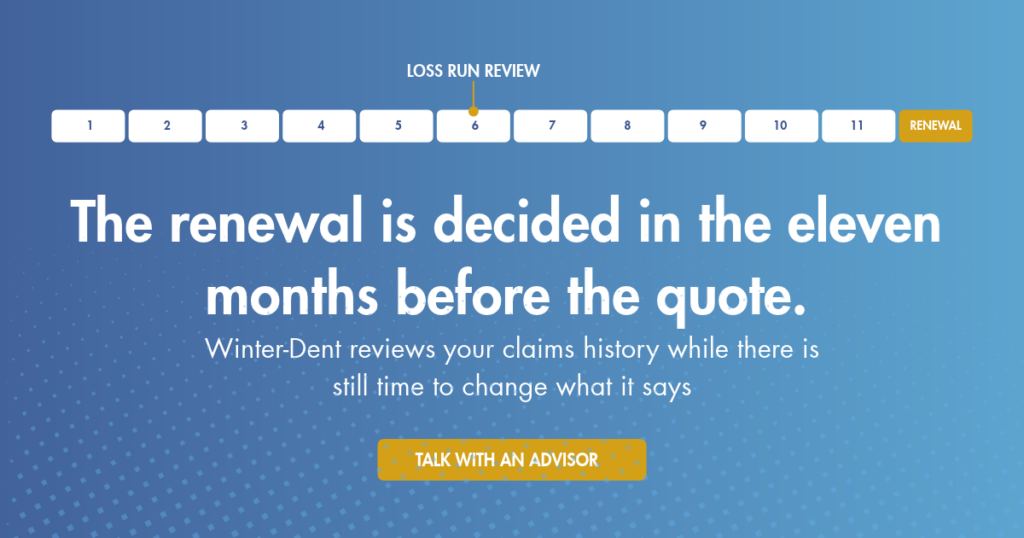
Renewals get decided by what happened in the eleven months before the quote, not the three weeks after it. Reading your loss run in June is what makes the December conversation a different conversation.
Learn more about the Prevent365 approach
What to Do With Your Loss Run This Month
None of which requires a renewal on the calendar to get started on.
- Request five years of loss runs from your current and prior carriers, and check the valuation date on each one
- List every open claim and note how long it's been sitting
- Flag any claim where the reserve looks out of proportion to what actually happened
- Read the descriptions and mark anything inaccurate or misleadingly vague
- Count claims by policy year and look for a frequency trend
- Identify the two or three claims driving most of your incurred losses
That's a working agenda, and it sits alongside the broader case for why you should start 120 days out on any renewal. For most businesses it also turns out to be a shorter list than they expected.
Want a Second Set of Eyes on Your Loss Run Report?
Winter-Dent reviews loss runs year-round instead of at renewal, so clients know what an underwriter will see before an underwriter sees it. If you'd like us to read yours, request a loss run review.
Frequently Asked Questions
Can a claim be removed from my loss run report?
Legitimate claims can't be removed, but errors can be corrected. Claims filed under the wrong entity, duplicates, claims denied or closed without payment, and inaccurate descriptions can all be disputed with the carrier. Reserves on open claims can be challenged too, when documentation supports a lower estimate. Corrections take time, which is why this needs to happen well before renewal.
How many years of loss runs do carriers actually want?
Most commercial underwriters ask for five years, and three is usually the minimum they'll accept for a competitive quote. Surety and larger property programs often want more. If you've changed carriers during that stretch, you'll need loss runs from each one, and gaps in the history tend to be treated less favorably than mediocre results.
Why did my premium increase when my loss run shows no new claims?
Open reserves from prior years are the usual culprit. A claim from three years ago that's still open is still counted at full incurred value. Market conditions, classification changes, payroll growth, and property valuations also move pricing on their own. A loss run review separates what's happening in the market from what's happening in your file.
Does an open claim hurt more than a closed one of the same value?
Generally, yes. A closed claim is a known cost. An open one carries development risk, and carriers price that uncertainty into your renewal. Two claims with identical incurred totals get viewed differently if one is settled and one isn't, which is why pushing closable files to closure before a valuation date has real pricing value.
When should we review our loss runs if renewal is six months out?
Six months out is exactly right. Reserve challenges, claim closures, and description corrections all take weeks to move through a carrier, and they need to be reflected before the valuation date used for your submission. Reviewing at 30 days leaves you documenting a history you can no longer do anything about.