
If an employee runs a work errand, visits a client, or picks up supplies in their own car, many business owners assume that employee's personal auto insurance handles any accident that happens along the way. It does not. Personal auto policies contain business use exclusions that can deny coverage precisely when a claim involves company business, leaving the employer exposed to the full cost of the accident.
The Myth: "That's Their Insurance, Not Ours"
This is one of the most common and most expensive assumptions in small and midsize business risk management. The logic feels sound on the surface. The employee owns the car, insures the car, and is driving the car. Why would the business carry any liability?
The answer lies in a legal principle called vicarious liability, sometimes referred to by the Latin term respondeat superior. When an employee causes an accident while acting within the scope of their job, whether that is a sales call, a bank run, or a delivery, the business itself can be named in the resulting lawsuit and held financially responsible, regardless of whose name is on the vehicle title.
The Reality: Personal Auto Policies Are Built to Exclude This
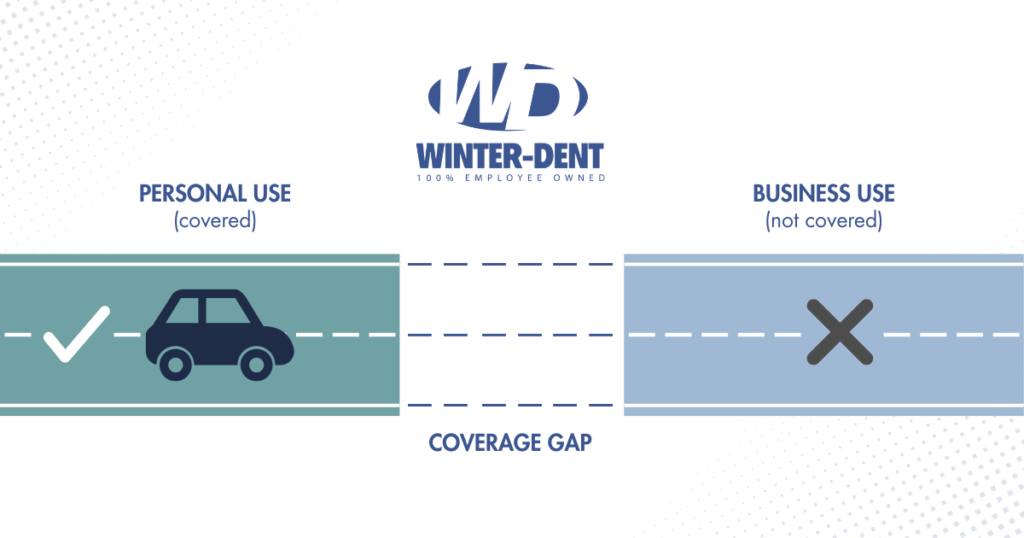
Personal auto insurance is priced and underwritten for personal use: commuting, errands, family trips. Nearly every personal auto policy contains language excluding coverage when the vehicle is being used for business purposes at the time of a loss. Insurers apply this exclusion in claims investigations as a matter of course, not as an edge case.
Quick Answer: Personal Auto PoliciesA personal auto policy typically excludes coverage for accidents that occur while a vehicle is being used for business purposes. When an employee causes an accident while running a work errand or visiting a client, their personal insurer can deny the claim, leaving the employer without a source of coverage unless a hired and non-owned auto (HNOA) policy is in place. |
That denial does not make the underlying liability disappear. It simply removes the insurance that would have paid for it. The injured party's attorney will still look for a source of recovery, and an uninsured employer is a far more attractive target than an insured one.
What This Actually Looks Like
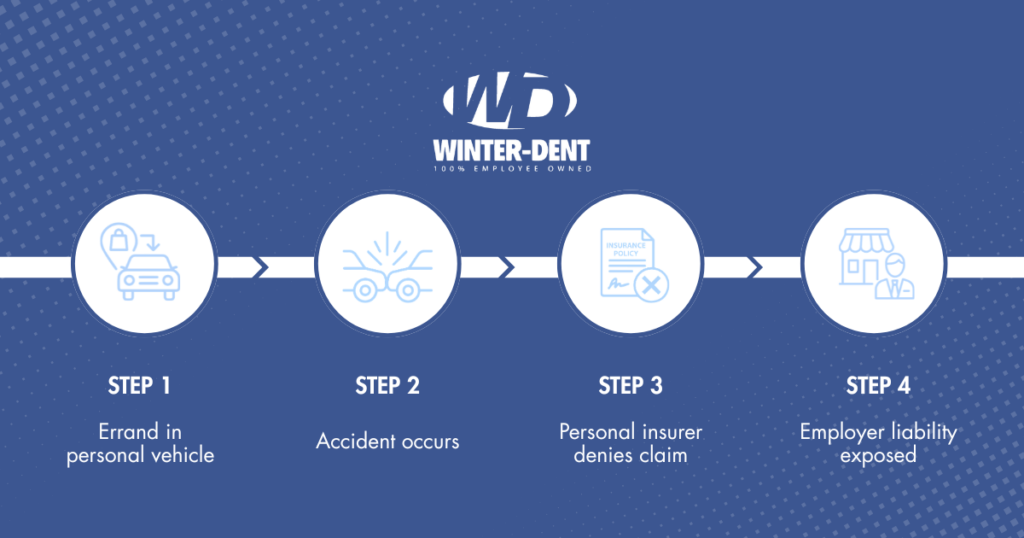
Consider a construction company office manager who drives her own car to pick up permits from the county courthouse and stops at a hardware store for the business on the way back. She is involved in an accident that seriously injures another driver. Her personal auto carrier reviews the claim, determines she was engaged in business activity at the time, and denies coverage under the business use exclusion. The injured party's attorney then pursues the employer directly, arguing the errand was performed within the scope of employment. Without hired and non-owned auto coverage, the business has no insurance response to a claim that could run into six or seven figures.
This scenario plays out constantly in businesses that have no company-owned vehicles at all, which is exactly why many owners assume commercial auto coverage does not apply to them.
What Most Businesses Do vs. What Proactive Businesses Do
| Most Businesses | Proactive Businesses |
|---|---|
| Assume employee car use is the employee's insurance problem | Identify every role that involves driving for company business, regardless of vehicle ownership |
| Only think about commercial auto if they own vehicles | Recognize that HNOA exposure exists with zero company-owned vehicles |
| Discover the gap when a claim is denied | Confirm HNOA is in place before an employee ever drives for work |
| Treat this as a one-time policy checkbox | Review which roles and activities create driving exposure as the business changes |
The Strategic Insight Most Businesses Miss
Business owners often treat commercial auto insurance as a fleet decision: how many trucks or vans do we own, and how do we insure them. That framing misses the more common and more overlooked exposure entirely. Hired and non-owned auto coverage is not about the vehicles a business owns. It is about the driving a business's employees do on its behalf, in vehicles the business does not own or control at all. A service business with zero company vehicles can carry meaningful exposure the moment an employee uses a personal car for a client visit.
This is precisely the kind of gap that a transactional approach to insurance misses. A broker who simply renews last year's policy has no reason to ask what roles in your organization involve driving. Identifying that exposure requires actually understanding how your business operates, not just what it currently insures.
Winter-Dent's Prevent365 methodology starts by diagnosing the root cause of risk before recommending coverage. For commercial auto, that means mapping out every way your people and vehicles move through your operations, including driving that never touches a company-owned car, so gaps like this are identified and closed before they become a claim.
Talk to a Winter-Dent advisor about whether your current program accounts for employee use of personal vehicles. It is a fifteen-minute conversation that can prevent a six-figure gap.
Do businesses need commercial auto insurance if they do not own any vehicles?Yes, if employees ever drive personal vehicles for work purposes such as client visits, errands, or deliveries. Hired and non-owned auto (HNOA) coverage protects the business from liability in these situations, since personal auto policies exclude business use and will not respond to a claim. |
See How This Fits Into a Complete Commercial Auto Program
This gap is one piece of a larger picture. Learn how a properly structured commercial auto insurance program addresses HNOA alongside liability limits, physical damage, and driver risk management, and see how Winter-Dent's Prevent365 approach diagnoses these exposures before they become claims.
Frequently Asked Questions About Commercial Auto Programs
Is hired and non-owned auto coverage the same as commercial auto insurance?
No. Commercial auto insurance covers vehicles the business owns and lists on the policy. Hired and non-owned auto (HNOA) coverage is a separate but related coverage that addresses liability arising from vehicles the business does not own, including rented vehicles and employees' personal cars used for work. Many businesses need HNOA even if they carry no commercial auto policy at all.
What roles in a business typically create this exposure?
Any role that involves driving for company purposes, even occasionally, creates this exposure. Sales representatives, service technicians, office staff running errands, HR staff conducting site visits, and executives traveling between locations all qualify. Frequency does not need to be high. A single accident during a single work-related trip is enough to trigger the exposure.
Does reimbursing employees for mileage change the liability picture?
No. Mileage reimbursement covers the employee's cost of using their vehicle, not the business's liability exposure. Reimbursing mileage does not create or eliminate HNOA exposure, and it does not change whether the personal auto policy's business use exclusion applies during a work-related trip.
How much does hired and non-owned auto coverage typically cost?
HNOA coverage is generally an inexpensive addition to a commercial general liability or commercial auto policy, especially relative to the liability it addresses. The specific cost depends on the number of employees who drive for business purposes, the nature of the driving involved, and the overall liability program structure. For most businesses, the cost is modest compared to the six and seven figure exposure a single serious accident can create.
If we have general liability insurance, are we already covered for this?
Not automatically. Standard general liability policies typically exclude auto-related liability entirely, regardless of who owns the vehicle. HNOA coverage is specifically designed to fill that gap and is usually added as an endorsement to a general liability or commercial auto policy rather than assumed to already be included.