
Underwriting cyber coverage is no longer a paperwork exercise. Here is what carriers actually look at, and how to shape the outcome before they do.
A few years ago, a cyber insurance renewal was a one-page form and a quick quote. Those days are gone. Today's cyber applications can run twenty pages, require attestations from a named executive, and trigger external scans before a single number is quoted. The result is a more rigorous process, higher premiums, and more denied claims when the answers do not match reality.
Most business leaders see the application and assume the carrier wants more paperwork. They do not. They want better information, because the cyber market has been losing money on policies written without it. Understanding what the carrier is actually looking at, and why, changes everything about how a business approaches its next renewal.
Here is what is happening on the other side of the table.
The Cyber Underwriting Process Has Fundamentally Changed
Five years ago, cyber insurance was a growth line. Carriers competed on price, asked few questions, and wrote policies aggressively. Then ransomware exploded, claim costs spiked, and the entire market reset. Underwriting now operates on three principles:
- Verify, do not trust. Carriers no longer take an applicant's word for it. External scans, third-party security ratings, and forensic claim reviews are standard.
- Reward documented maturity. Businesses that can prove their controls and processes get better terms. Those that cannot get loaded premiums, narrower coverage, or declination.
- Enforce conditions at claim time. Sublimits, attestations, and required controls are no longer fine print. They are the basis on which claims are paid or denied.
This shift has put the responsibility for cyber readiness back where it belongs: on the business, not the carrier. The companies adapting to this reality are the ones earning better coverage at lower cost. The ones still treating cyber as a transactional purchase are the ones absorbing the increases.
How do insurance carriers evaluate cyber risk?
Carriers evaluate cyber risk through four primary inputs: the application and executive attestation, third-party security ratings, loss history, and industry profile. The application surfaces controls and processes. The security rating verifies external exposure. Loss history shows past frequency and severity. Industry profile sets baseline expectations. Together they determine premium, coverage breadth, and whether the carrier will offer terms at all.
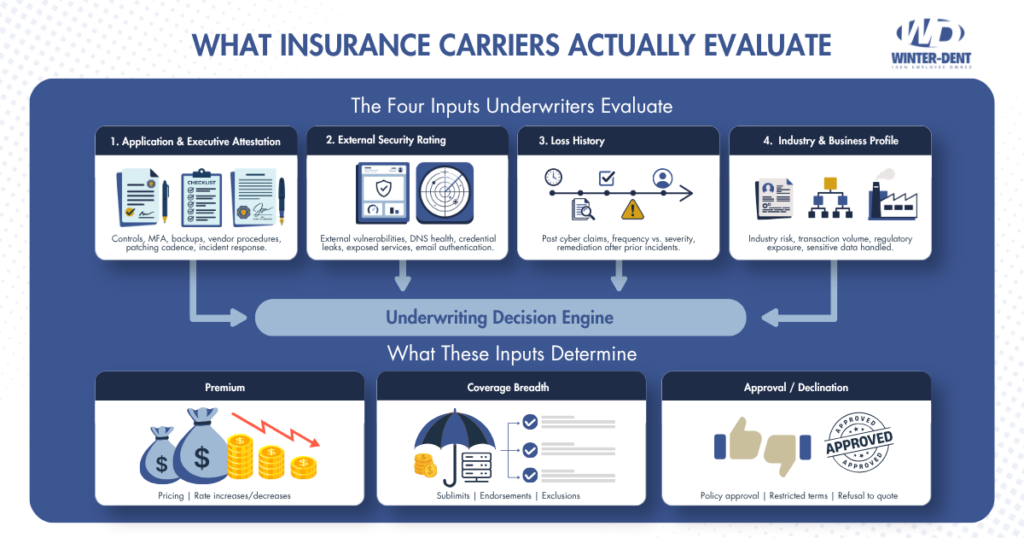
The Four Things Underwriters Actually Look At
1. The Application and Executive Attestation
The application is the primary source of underwriting information, and it is also a legal document. Most cyber applications now require a named officer or executive to attest, under signature, that the answers are accurate at the time of signing.
Key areas the application probes:
- Authentication. Is multi-factor authentication enabled across email, remote access, and privileged accounts?
- Endpoint protection. Is endpoint detection and response deployed across all devices, or is the company still relying on traditional antivirus?
- Backups. Are backups encrypted, segmented from the production network, and tested for restoration?
- Email security. Are SPF, DKIM, and DMARC implemented? Is there email filtering for known phishing and impersonation patterns?
- Vendor and wire processes. Are banking changes verified by callback? Are dual controls required for outgoing wires?
- Patching cadence. How quickly are critical patches applied across servers, endpoints, and external services?
- Incident response. Is there a documented and tested incident response plan?
Carriers do not ask these questions for their files. They ask because every "no" or "partial" answer affects pricing, terms, and the carrier's willingness to write the account at all.
2. The External Security Rating
In the last five years, third-party security ratings have moved from optional context to standard underwriting input. Carriers run external scans against the applicant's domain and infrastructure to verify what the application claims.
A security rating evaluates publicly visible signals like patching cadence, exposed services, email authentication, leaked credentials, and DNS health. The rating gives the underwriter a second view of the business that is independent of the application. If the application says "we are fully patched" and the external scan finds critical vulnerabilities exposed for nine months, the gap becomes a pricing problem or a denial.
The strategic insight here is that a business can run the same kind of scan on itself before applying. The carrier sees the same data either way. The only difference is whether the business saw it first and had time to address the issues.
3. Loss History
Loss runs from prior cyber policies show the carrier what has actually happened to the business. A clean record is positive. A history of frequent small claims signals a control problem. A history of one or two large claims signals exposure to severe events.
What underwriters look for in loss history:
- Frequency vs. severity. Many small claims suggest weak process discipline. A single large claim suggests a high-impact gap that may or may not have been addressed.
- Root cause patterns. Repeated phishing-related losses raise different concerns than a single ransomware event.
- Remediation evidence. A loss followed by documented changes to controls is treated very differently from a loss with no operational response.
Loss history is the one input the business cannot rewrite. But it is also the input where context matters most. A well-documented submission that explains what was learned and what changed after a prior loss can soften the impact dramatically.
4. Industry and Business Profile
Some industries face higher cyber risk than others. Construction, healthcare, professional services, manufacturing, and financial services each carry distinct exposure profiles that carriers price differently. Within each industry, carriers look at company size, revenue, geographic footprint, transaction volume, regulatory environment, and the type of sensitive data handled.
This is the input where the business has the least control, but the most opportunity to differentiate. Two construction firms of the same revenue can present radically different risk profiles depending on their controls, their vendor processes, and their documented response readiness. The application and the rating are how the business proves it is the better of the two.
What Most Businesses Submit vs. What Proactive Businesses Submit
| Reactive Submission | Proactive Submission |
| Application completed from memory or by IT vendor | Application completed with verified evidence and executive review |
| External rating discovered by the carrier | External rating shared proactively with remediation context |
| Loss history presented without explanation | Loss history paired with documented operational changes |
| Submission arrives at carrier without preparation | Submission arrives with supporting documents organized in advance |
| Underwriter reaches out with questions and concerns | Underwriter receives a clean, complete package on day one |
The companies on the right side of this table consistently earn better terms, broader coverage, and lower premiums than the companies on the left, often for the same underlying risk. The difference is preparation, not luck.
What can I do before renewal to lower my cyber insurance premium?
The most effective actions before renewal are running an external security rating against your business, verifying the controls listed on your last application, documenting any changes since the last renewal, and preparing a clean, complete submission package in advance. Each of these reduces underwriting friction and improves the terms the carrier is willing to offer.
The Strategic Insight Most Brokers Miss
Most brokers treat the renewal as a deadline to meet. The proactive ones treat it as a structured opportunity to reshape the carrier's view of the account. The difference shows up in three places.
First, in timing. Starting the renewal conversation sixty to ninety days early gives the business time to identify gaps, make changes, and document the improvements before the application is signed. Starting two weeks before expiration leaves no time to change anything that matters.
Second, in evidence. A submission that includes the external rating, a written summary of controls, evidence of training, and an incident response plan reads completely differently than a submission with just the application. The underwriter is no longer guessing. The business has done the work of telling the story.
Third, in framing. Loss history, especially recent loss history, can be re-framed by what the business did in response. A documented remediation plan after a prior loss is one of the most powerful pieces of underwriting evidence available, and almost no one submits it.
This is the part of cyber insurance that most businesses never see, because most brokers never run the play. The renewal is not a paperwork moment. It is the only moment in the year when the business has direct leverage over the carrier's view of the account.

How Winter-Dent Approaches Cyber Underwriting
Winter-Dent treats every cyber renewal as a strategic submission, not a transactional one. Our Prevent365 methodology applies four steps that align directly with the underwriting process.
Diagnose. We start with a complimentary external assessment using the same data carriers use. The findings tell us where the underwriter is going to push and what to address before they do.
Differentiate. We build a submission that demonstrates documented controls, a strong external rating, and a clear narrative around any prior losses. The goal is to be the easiest, cleanest account on the underwriter's desk.
Reduce. We coordinate with your existing IT provider to close the gaps that matter most for the carrier and for your operation. We do not sell software or replace your IT vendor. We make sure the work being done lines up with what the carrier expects.
Insure. The policy is structured around what your business actually faces, with sublimits, retentions, and endorsements that reflect real exposure. The application is signed with confidence because the answers are documented and verifiable.
The result is better terms, broader coverage, and a defensible record at claim time.
What to Do Before Your Next Cyber Renewal
If your renewal is more than ninety days out, the most useful thing you can do this quarter is talk to your Winter-Dent advisor. We can walk through what a carrier's security scan is likely to flag, so you can address issues, document the changes, and walk into renewal with leverage instead of liability.
Reach out to your Winter-Dent advisor to start that conversation.
Frequently Asked Questions About What Insurance Carriers See When They Evaluate Your Cyber Risk
How do insurance carriers verify what I put on my cyber application?
Carriers verify through a combination of external scans, third-party security ratings, follow-up questions, and forensic review at claim time. They use independent data sources to confirm controls like email authentication, exposed services, and credential leaks. At claim time, they reconstruct the controls that were actually in place at the moment of the incident, which is when application accuracy matters most.
Why are cyber insurance applications so much longer than they used to be?
The cyber market lost significant capital writing thin applications between 2018 and 2022. Carriers responded by demanding far more underwriting information, particularly around controls that correlate with claim outcomes. Applications now cover authentication, endpoint protection, backups, email security, patching, vendor processes, and incident response in detail. The longer application is the price of a healthier market.
Can a third-party security rating actually lower my cyber insurance premium?
Yes, when used proactively. A strong rating shared with the submission supports better terms and lower premiums because it gives the underwriter independent verification of the application. A rating discovered by the carrier without context can have the opposite effect. The strategic move is to run the rating internally, address visible issues, and present the improved rating as part of the renewal submission.
What is the single most important control for cyber insurance eligibility?
Multi-factor authentication is consistently the most critical control. MFA failures are the leading enabling factor in cyber claims, and carriers treat its absence as a serious credit issue. MFA on email and on remote access is usually a hard requirement for any meaningful coverage. Beyond MFA, endpoint detection and tested backups are the next two most important.
How early should I start preparing for my cyber insurance renewal?
Sixty to ninety days before expiration is the standard for a proactive renewal. That window allows time to run an external rating, identify gaps, coordinate with IT to address them, document the improvements, and assemble a clean submission. Starting inside thirty days limits the business to whatever terms the carrier is willing to offer based on the current posture, with no time to change it.