
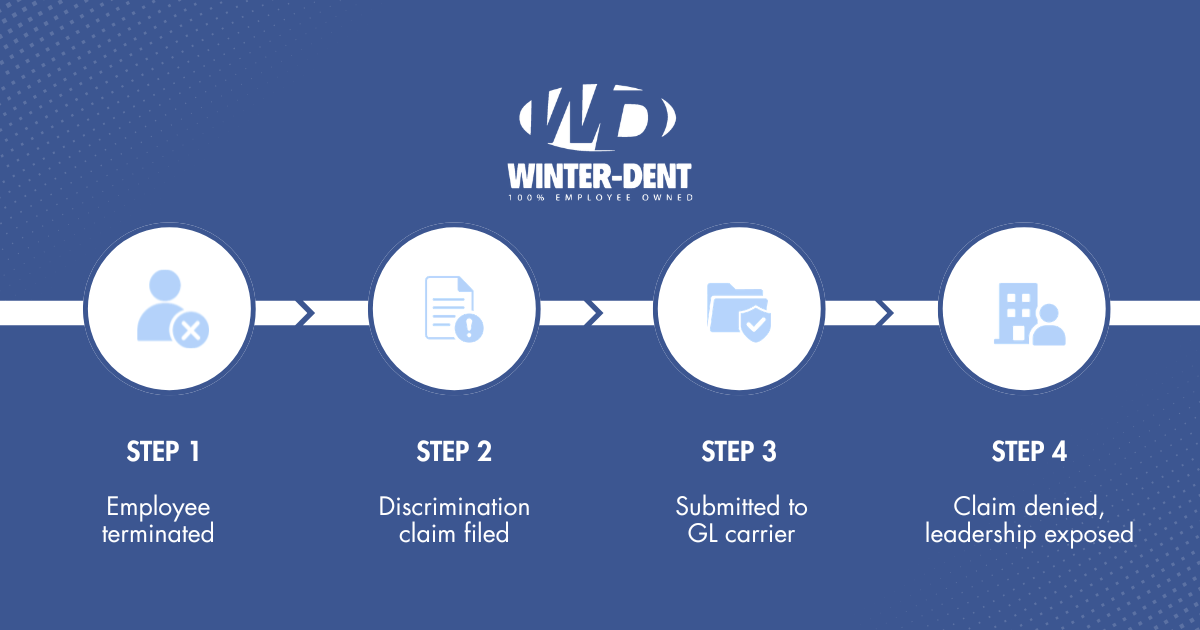
Most business owners believe their general liability insurance protects the business against lawsuits broadly. It does not. General liability covers bodily injury and property damage claims from third parties, and it explicitly excludes claims arising from management decisions, employment practices, and benefit plan administration, the exact categories most likely to name your leadership team personally.
The Myth: "Our General Liability Policy Has Us Covered"
This assumption is one of the most consequential misunderstandings in small business insurance, precisely because it feels reasonable. Business owners buy a general liability policy, are told it protects the business "if something happens," and reasonably conclude that "something" includes any lawsuit the business might face.
General liability was never designed to work that way. It is built to respond to a specific category of claim: bodily injury or property damage caused to a third party by the business's operations, products, or premises. A customer slips and falls. A product causes damage. A contractor's work damages a client's property. These are the claims general liability exists to address.
Quick Answer: What Does General Liability Cover?General liability insurance covers third-party claims of bodily injury and property damage. It does not cover claims arising from management decisions, employment practices such as wrongful termination or discrimination, or the administration of employee benefit plans. Those categories require directors and officers, employment practices, and fiduciary liability coverage, collectively known as management liability insurance. |

Where the Assumption Breaks Down
Consider a business that terminates an underperforming manager. The former employee files a claim alleging discrimination and retaliation. The business owner, confident their insurance has them covered, submits the claim to their general liability carrier.
The claim is declined. General liability policies contain explicit exclusions for employment-related claims, precisely because this category of risk is addressed by a separate coverage line, employment practices liability (EPL). Without EPL coverage in place, the business faces the full cost of defense and any settlement or judgment directly, and in many cases, that exposure extends to the leadership team's personal assets if the business cannot fully indemnify them.
The same gap exists for claims alleging a leadership decision was negligent or a breach of duty (requiring D&O coverage), and for claims alleging mismanagement of a retirement or benefit plan (requiring fiduciary liability coverage). None of these fall under a general liability policy, regardless of how comprehensive that policy appears.
What Most Businesses Assume vs. What Proactive Businesses Confirm
| Most Businesses Assume | Proactive Businesses Confirm |
|---|---|
| "We have insurance" means all lawsuits are covered | Exactly which categories of claim their general liability policy responds to |
| Employment claims are a general liability issue | Whether EPL coverage is in place for wrongful termination, discrimination, and harassment claims |
| Leadership decisions are protected the same way property damage is | Whether D&O coverage exists to protect leadership from claims of alleged wrongful acts |
| Retirement plan oversight is an HR function, not an insurance issue | Whether fiduciary liability coverage protects those responsible for plan administration |
| Coverage gaps get discovered when a claim is filed | Coverage gaps get identified during an annual program review, before a claim occurs |
The Strategic Insight Most Businesses Miss
The deeper issue is not that business owners are careless. It is that "insurance" gets treated as a single, undifferentiated protection rather than a set of distinct coverage lines, each built to respond to a specific category of claim. General liability, management liability, and workers' compensation are not overlapping versions of the same protection. They are separate tools addressing separate exposures, and a business can be fully insured in one category while carrying zero coverage in another.
This matters more, not less, as a business grows. Every hire, every leadership change, every benefit plan decision, and every shift in employment law creates new exposure in the categories general liability was never built to address. A business that has never reviewed whether it carries D&O, EPL, and fiduciary coverage alongside its general liability program has likely never had this gap identified, because a standard renewal does not surface it.
Winter-Dent's Prevent365 methodology addresses this directly by reviewing your organizational structure, workforce practices, and governance alongside your existing coverage, rather than assuming your current program already accounts for every category of exposure your leadership team actually faces.
Talk to a Winter-Dent advisor about whether your current program includes management liability coverage alongside general liability. It is a conversation worth having before a claim forces it.
Does general liability insurance protect business owners and executives from lawsuits over their decisions?No. General liability covers third-party claims of bodily injury and property damage. Claims involving management decisions, employment practices, or benefit plan administration require separate coverage, directors and officers (D&O), employment practices liability (EPL), and fiduciary liability, collectively referred to as management liability insurance. |
See How This Fits Into a Complete Protection Program
Understanding this gap is the first step toward closing it. Learn how a coordinated management liability insurance program brings D&O, EPL, fiduciary, and crime coverage together, and see how Winter-Dent's Prevent365 approach identifies these gaps during an annual governance review.
Frequently Asked Questions
If we have never had an employment claim, do we still need EPL coverage?
Yes. Employment practices liability claims can arise even in organizations with strong HR practices, since claims are based on an employee's allegation, not a confirmed policy violation. The absence of past claims does not indicate future exposure is low. It often simply means the organization has not yet been tested, and defense costs alone for an EPL claim can be substantial even when the claim is ultimately unsuccessful.
Can our leadership team be personally responsible for a claim if the business is properly insured for general liability?
Yes, if the claim falls into a category general liability does not cover. Without D&O coverage, and specifically Side A coverage that protects individuals when the company cannot indemnify them, claims alleging a wrongful management decision can reach personal assets, regardless of how much general liability coverage the business carries.
Does workers' compensation cover employment-related lawsuits like discrimination or wrongful termination?
No. Workers' compensation covers workplace injuries and illnesses through a no-fault system and does not respond to claims alleging discrimination, wrongful termination, harassment, or retaliation. Those claims require employment practices liability (EPL) coverage, a separate line entirely from workers' compensation.
Is management liability insurance only necessary for businesses with a formal board of directors?
No. Private companies without a formal board still make management decisions, employ people, and in many cases sponsor benefit plans, all of which create D&O, EPL, and fiduciary exposure. The presence or absence of a formal board affects governance structure, not whether the underlying legal exposure exists.
How do we find out whether our current insurance program already includes management liability coverage?
The most direct way is a program review with your insurance advisor, comparing your current policy schedule against the four core management liability lines: D&O, EPL, fiduciary, and fidelity and crime. Many businesses discover they carry one or two of these lines but not all four, leaving specific categories of claim uninsured.