

If a project just came across your desk that's bigger than anything your surety has approved you for, you've probably already run into the uncomfortable part. Bonding capacity isn't something you can go get, it's something you build, and the building takes quarters rather than weeks.
The better news is that it's more controllable than most contractors assume, since capacity comes out of a handful of financial and operational inputs and every one of them responds to deliberate decisions. The catch is only that those decisions have to be made well before you need the result, which makes understanding the mechanics worth the time.
What Is Bonding Capacity?
Bonding capacity is the maximum bond amount a surety will write for your company, expressed two ways: a single-project limit for the largest individual job, and an aggregate limit covering all bonded work at once. It's based primarily on your working capital, net worth, financial reporting quality, and track record.
Two things in that definition are worth pausing on. The first is that capacity isn't a number you're entitled to, since it's an underwriting judgment revisited on a cycle and it can go down as well as up. The second is that the two limits are separate constraints, which is why plenty of contractors have room under one and not the other, and why a job can get declined even when it sits comfortably under the single-project number. Your backlog is spending aggregate capacity whether you're thinking about it or not.
When You Actually Need a Bond
Before getting into how those limits get set, it helps to know where the requirements bite.
If you're bidding public work in Missouri, state law requires public works contractors to furnish a bond with sufficient sureties in an amount set by the public entity, and the state's prompt-payment provisions reference a $50,000 threshold below which that requirement doesn't attach. Federal work has its own trigger, since prime contractors on federal construction contracts above $150,000 have to furnish a performance bond.
If you can't yet get bonded through conventional channels, there's a bridge worth knowing about. The SBA's Surety Bond Guarantee Program backs bid, performance, and payment bonds on individual contracts up to $9 million, or $14 million on federal contracts when a contracting officer certifies the need, with the SBA guaranteeing 80 to 90 percent of the surety's loss in a default. In fiscal 2024 it supported 11,092 bonds representing $9.21 billion in contract value. It exists specifically for growing contractors, and a surprising number of eligible companies have never looked at it.
What Your Surety Is Actually Asking
With the requirements established, here's the idea that makes the rest of the underwriting make sense.
Your surety isn't primarily evaluating your company. They're evaluating your company's ability to absorb a bad project.
That single reframe explains most of the decisions contractors find confusing. It's why a profitable company with thin working capital gets a lower limit than a less profitable one with a strong balance sheet, why year-end distributions hurt, and why an unused line of credit helps even though you're not using it. In every case the surety is modeling what happens on the worst job you'll ever take, so anything that thickens your cushion raises your limit.
Read the next section with that in mind and the five inputs stop looking like a checklist and start looking like one question asked five different ways.
The Five Things That Set Your Limit
Working capital comes first, since it's current assets minus current liabilities and the biggest single driver. Sureties extend capacity as a multiple of it, which is why the SBA describes its program in terms of helping contractors qualify beyond conventional working capital standards.
Net worth and structure backstops that figure and signals staying power, so sureties look at how much equity stayed in the business versus went out the door, whether debt is structured sensibly, and whether a bank line is available as a cushion. Distributions deserve a specific mention here, because a contractor who takes profits out at year end is making a defensible business decision and capping their own capacity at the same time. That tradeoff should at least be a conscious one.
Financial reporting quality is the most overlooked lever on the list, because the same financials presented three ways will support three different capacity figures. A compilation, a review, and an audit carry escalating assurance, and sureties price that assurance into their comfort, as they do a properly built work in progress schedule using percentage of completion with clean underbillings and overbillings. Contractors often balk at the cost of moving from a compilation to a review, but for a company trying to grow, it's frequently the cheapest capacity you'll ever buy.
Track record and backlog addresses whether you've successfully finished work at or near the size you're now asking for. A surety asked to approve a $4 million job for a contractor whose largest completed project is $1.2 million is being asked to underwrite a step change, so they'll want to understand why it's manageable. Current backlog counts too, since it's already consuming aggregate room.
Character and operations covers reference checks, relationships with subs and suppliers, claims and litigation history, and the quality of your internal systems. Continuity matters more here than contractors expect, because a company with no succession plan and no clear second-in-command carries a risk that shows up directly in the limits.
Why Your Working Capital Isn't the Number You Think
Since working capital drives the most, it's worth going back to it, because this is where a lot of disappointment comes from.
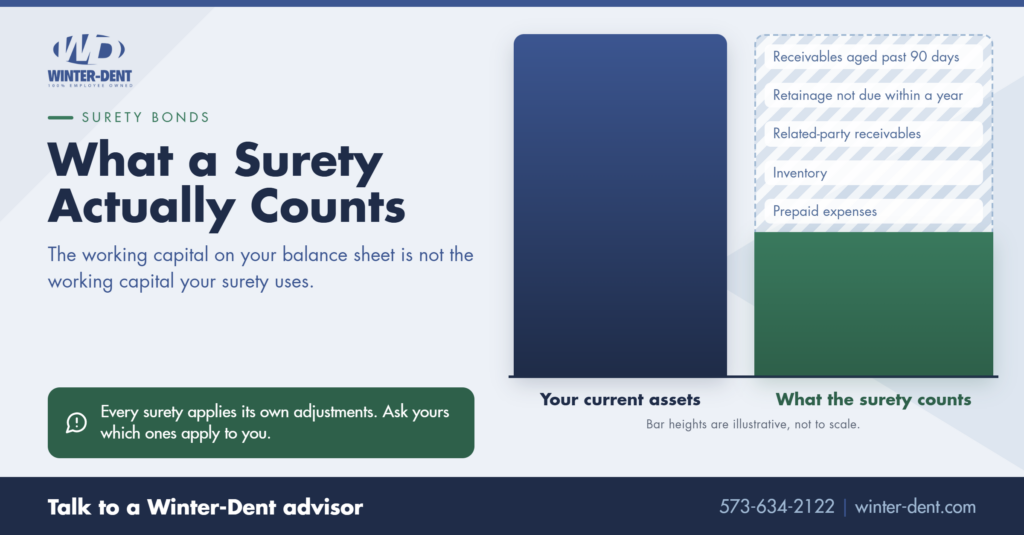
The working capital figure on your balance sheet is not the figure your surety uses. They apply their own adjustments first, and the gap between the two numbers is often substantial. Commonly discounted or excluded are receivables aged past 90 days, retainage not due within a year, related-party receivables, inventory, and prepaid expenses.
Which means two companies with identical current ratios can present very different surety-adjusted working capital, and a contractor can be running what looks like a clean balance sheet while carrying a capacity problem they don't know about.
Every surety applies its own version of this, so the useful move is simply to ask yours which adjustments they make to your statements, then work on the ones you can influence.
How Long Does It Take to Increase Bonding Capacity?
Once you know which levers to pull, the next question is when any of it pays off.
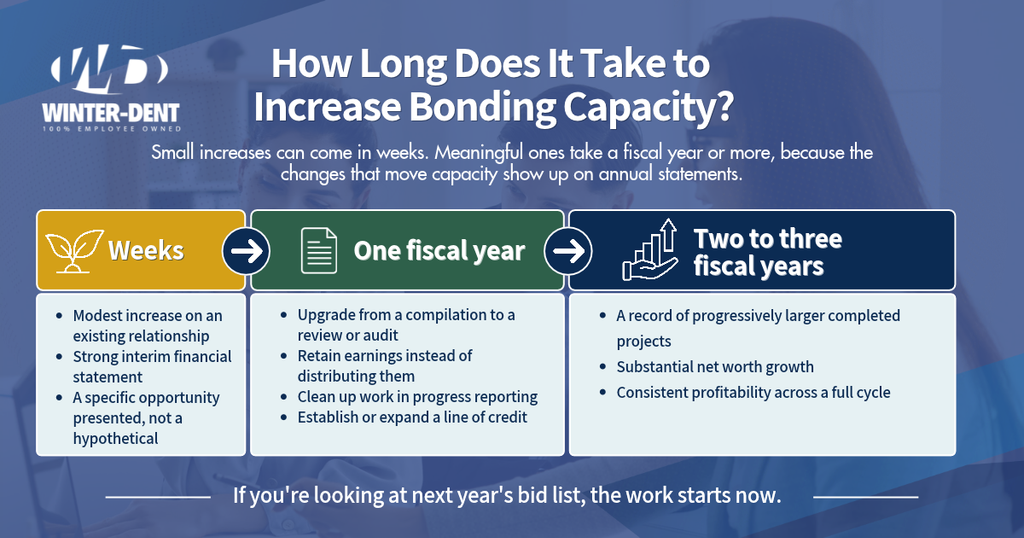
Direct answer: Small increases can come within weeks if your surety already knows you and the request is modest. Meaningful increases usually take one to two fiscal years, because the changes that move capacity, retaining earnings, upgrading financial reporting, and completing larger projects, show up on annual statements.
That timeline is the part contractors most often learn too late. Realistically:
- Weeks. A modest bump on an existing relationship, especially with a strong interim statement and a specific opportunity attached.
- One fiscal year. Upgrading from a compilation to a review or audit, retaining earnings instead of distributing them, cleaning up work in progress reporting, establishing or expanding a line of credit.
- Two to three fiscal years. Building a record of progressively larger completed projects, growing net worth substantially, showing consistent profitability across a cycle.
So if you're looking at next year's bid list, the work starts now rather than in the spring when the bids come out.
What Most Contractors Do Versus What Growing Contractors Do
Which is really a difference in habits more than in resources, and it's clearer side by side.
| Most contractors | Contractors who grow capacity | |
| When they engage the surety | When a bid requires a bond they don't have | Quarterly, with interim financials |
| Financial statements | Compilation, prepared for the tax return | Review or audit, prepared with the surety in mind |
| WIP schedule | Assembled when someone asks | Maintained monthly, reconciled, reviewed by the CPA |
| Year-end profits | Distributed | Modeled against the capacity they buy |
| Project sizing | Bid the biggest thing available | Step up deliberately, one tier at a time |
| Line of credit | Opened when cash gets tight | Established and unused, as a visible cushion |
| The conversation | "Can you bond this job?" | "Here's where we're going. What do we need to get there?" |
The right column isn't more expensive than the left, since it's mostly the same activity sequenced earlier and shared with the right person.
Ask for a Plan, Not a Number
That last row is the one worth sitting with, because it changes the nature of the relationship.
The most effective capacity conversation isn't a request. It's a three-year picture: what you intend to bid, what the balance sheet will look like, what reporting you're moving to, and what you'd need from them along the way.
Contractors who bring that get treated as partners in a plan rather than applicants for a number, which makes sense from the surety's side too. They'd much rather grow alongside a contractor they understand than repeatedly evaluate one who only shows up when something is due Friday.
Where Prevent365 Fits
All of which makes bonding capacity the clearest example of what Prevent365 means by Build for Impact.
Nothing about capacity gets decided in the moment. It's the accumulated result of how you structured your financials three years ago, whether you retained earnings last December, how you've reported work in progress every month since, and whether the projects you finished built a record or just kept the lights on. A surety reading your file in March is reading thirty-six months of decisions.
And the same discipline shows up elsewhere in your risk profile, since your experience modification rate, which many general contractors use as a prequalification gate, gets built exactly the same way out of claims history that follows you for three to five years. Contractors who work on one usually find the other improving alongside it.
What to Do This Quarter
Five things, none of which require a bid on the table.
- Ask your surety what your current single-project and aggregate limits are, and how much aggregate room your backlog is using right now
- Ask which adjustments they make to your working capital, and get the specifics
- Talk to your CPA about what moving up a level of assurance would cost and what it would take
- Model your year-end distribution against the capacity it costs you, before December rather than after
- Write down the largest project you want to bid in the next two years, and take that number to your surety as a conversation starter
That last one changes the relationship more than the other four combined.
Thinking about bigger work next year? We'll look at where your capacity sits today, what's constraining it, and what would have to change to reach the number you have in mind. Talk with Winter-Dent's Surety team.
#image_title
Frequently Asked Questions
What is a letter of bondability, and does it prove I have capacity?
A bondability letter is a statement from your surety indicating a general willingness to bond your company, often used to satisfy a prequalification requirement. It's not a commitment. It doesn't guarantee a specific bond will be approved, and it doesn't establish a hard capacity figure. Owners generally accept it as a screening document, but the actual underwriting still happens per project.
Why do surety companies care so much about net worth if the bond is for a specific job?
Because the surety's exposure isn't limited to the job. If you default, they complete the work and then pursue you under the indemnity agreement. Net worth is the measure of what's actually behind that indemnity. A contractor with strong revenue and thin equity looks very different to an underwriter than one with the same revenue and retained earnings on the balance sheet.
How much do construction bonds cost, and does higher capacity cost more?
Bond premium is typically a percentage of the contract value, and the rate generally improves as a contractor's financial strength improves. So higher capacity often comes with a better rate rather than a worse one, since both reflect the same underwriting assessment. Rates vary by surety, contract size, and work type, so the only reliable figure is a quoted one.
Will taking a distribution this year hurt my bonding capacity?
It can, meaningfully. Distributions reduce both working capital and net worth, which are the two largest inputs to your limits. That doesn't mean don't take them. It means model the tradeoff before year end, because a distribution made in December can constrain what you're able to bid the following summer, and by then the decision can't be reversed.
Do I need audited financial statements to get bonded?
Not at smaller capacity levels, where a CPA-prepared compilation or review is often sufficient. As requested limits rise, sureties generally expect stronger assurance, and an audit becomes the practical requirement somewhere in the low millions depending on the surety. Upgrading before you need to is usually the cheaper path, since the improved reporting can support a higher limit immediately.
Can my bonding capacity go down?
Yes, and it happens more often than contractors expect. A loss year, a significant distribution, deteriorating receivables, a claim, losing key personnel, or simply a backlog that grows faster than the balance sheet can all reduce available capacity. Because limits get reviewed on a regular cycle, a company can find itself with less room than it had at the last renewal without anything dramatic having occurred.