
Most small business owners are not careless about insurance. They are busy. Coverage gets bought when the business opens, renewed each year and reviewed one policy at a time, usually when a renewal notice shows up.
Meanwhile, the business keeps changing. New employees, new equipment, a bigger space, a new client contract, a delivery van. Each change can shift what the business needs from its insurance, and many of those changes never make it back to the agent.
The result is common. According to a 2026 survey by ERGO NEXT, 73% of small businesses are underinsured, and 32% of those owners said the gaps were too confusing to find on their own.
The good news is that most gaps are easy to spot once someone looks at all of your coverage together. Here are seven we see often, and the questions worth asking about each.
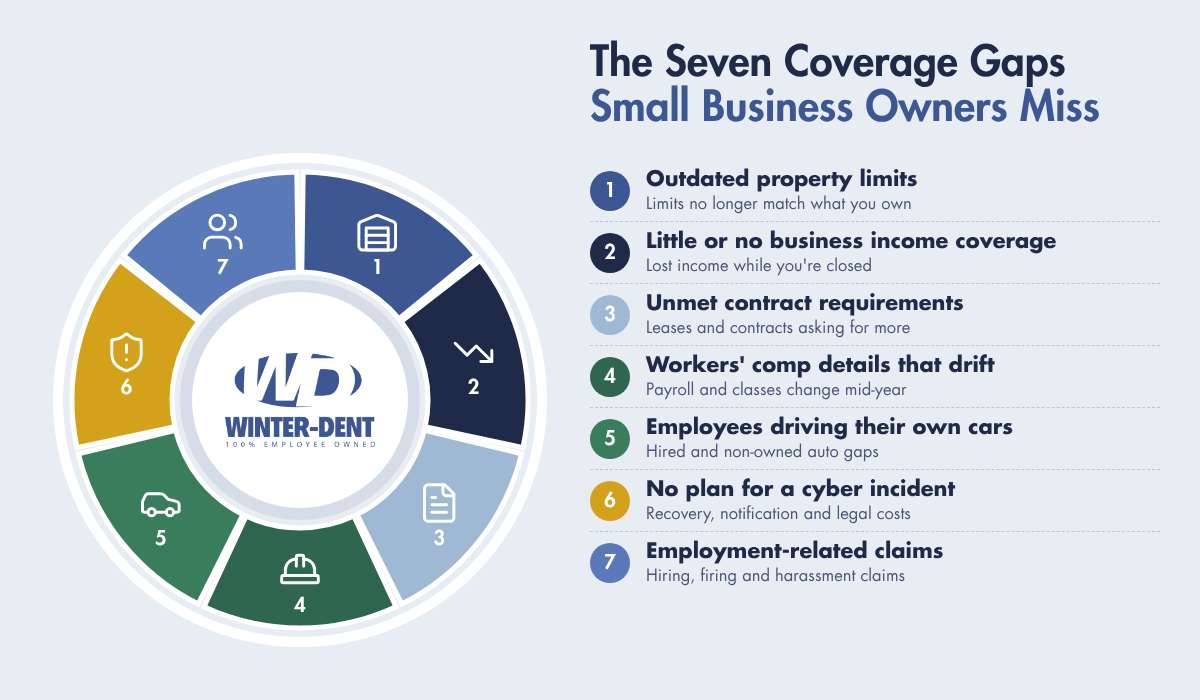
1. Property limits that no longer match what you own
When a policy is first written, its limits reflect what the business owned at the time. Over the years, owners add equipment, upgrade technology, build out space and carry more inventory. If those changes are not shared, a policy may cover less than the business would need to replace after a fire or storm. (See also: what happens if you are underinsured after a major storm.)
Questions to ask:
- Do the limits on my policy still reflect the equipment, inventory and improvements I have today?
- Is my business personal property covered at replacement cost or actual cash value?
- Are items I take off-site, like tools or laptops, covered?
2. Little or no business income coverage
Property coverage helps you repair or replace what was damaged. It does not, on its own, replace the income you lose while you are closed. Business income coverage can help pay ongoing expenses like payroll, rent and loan payments during a covered shutdown.
Questions to ask:
- Do I have business income coverage, and for how long would it pay?
- Does it include extra expense coverage to help me reopen faster?
- What happens if a key supplier or customer is shut down?
3. Contract requirements your policies do not meet
Leases, client contracts and loans often require specific insurance: certain liability limits, additional insured wording, waivers of subrogation or proof of an umbrella policy. These requirements are easy to sign and easy to forget.
Questions to ask:
- Have I shared my current contracts and lease with my agent?
- Do my liability limits meet what those agreements require?
- Would an umbrella policy help me meet higher limits more affordably?
4. Workers' compensation details that drift
Workers' comp premiums are based on payroll and job classifications. Both can change during the year as you hire, promote and take on new kinds of work. Subcontractors without their own coverage can also become your responsibility at audit time.
Questions to ask:
- Are my employees classified correctly for the work they do today?
- Is my estimated payroll still accurate?
- Do I collect certificates of insurance from every subcontractor?
5. Employees driving their own cars for work
If an employee runs to the bank or visits a client in their own car and causes an accident, their personal auto policy is usually expected to respond first. But if the damages exceed their limits, the business may be pulled in. Many owners are surprised to learn that a standard business policy may not cover this.
Questions to ask:
- Do I have hired and non-owned auto coverage?
- Are the vehicles the business owns listed and rated correctly?
- Do I check the driving records of employees who drive for work?
6. No plan for a cyber incident
Small businesses are frequent targets because they often have fewer defenses. Ransomware appeared in 83% of small and midsize business breaches in the 2026 Verizon Data Breach Investigations Report. A single incident can lead to lost revenue, recovery costs and notification requirements.
Questions to ask:
- Does any of my current coverage respond to a cyber incident or data breach?
- Would I have help with recovery, notification and legal costs?
- What basic controls, like multi-factor authentication and backups, do carriers expect?
7. Employment-related claims
Claims tied to hiring, firing, harassment or discrimination can happen at any business with employees, even when the business did nothing wrong. Defending against them can be expensive, and general liability policies are generally not designed to cover them.
Questions to ask:
- Do I carry employment practices liability insurance (EPLI)?
- Does my policy include access to HR guidance or legal hotlines?
- Are my employee handbook and policies up to date?
Two more things worth a look
Employee benefits. If you are thinking about offering health coverage or other benefits to attract and keep good people, a checkup is a good time to ask what is realistic for a business your size.
Your own household. Business owners often have more personal exposure than they realize: a rental property, a teen driver, a boat or significant savings. A personal umbrella and an annual home and auto review can close gaps outside the business.
How a Small Business Coverage Checkup works
You do not need to become an insurance expert to find these gaps. That is our job.
A Small Business Coverage Checkup is one conversation with a Winter-Dent advisor, usually about 30 minutes. We look at your property, liability, workers' comp, commercial auto and cyber coverage side by side, confirm that what you carry still matches how you operate, and flag anything worth a closer look.
There is no cost, and there is no pressure to change anything. If your coverage looks right, we will tell you.
To get the most from the conversation, have these handy if you can:
- Your current policies or declarations pages
- Any contracts or leases with insurance requirements
- A rough count of employees and vehicles
- Recent or planned changes: new equipment, locations, services or hires

Want to start on your own? Download our free Small Business Coverage Checkup guide. It walks through the same questions our advisors ask.
The Prevent365 approach
At Winter-Dent, we call our approach Prevent365: prevent what you can, contain what you can't, and insure only what truly can't be controlled. A checkup is the first step, diagnosing what is really driving your risk, so the rest of your coverage decisions rest on a clear picture.
Frequently asked questions
What is a small business insurance checkup?
It is a review of all of your business insurance together, typically property, liability, workers' comp, commercial auto and cyber, to confirm your coverage still matches how your business operates and to find gaps between policies.
How often should a small business review its insurance?
At least once a year, and any time the business changes in a meaningful way, such as adding employees, equipment, locations, vehicles or new types of work.
What does it mean to be underinsured?
Being underinsured means your coverage would not fully pay for a loss, because limits are too low, a type of risk is not covered or a policy does not respond the way you expected.
Does Winter-Dent charge for a Small Business Coverage Checkup?
No. The checkup is offered at no cost, whether or not you decide to make changes.