
For years, most small and mid-size employers had two choices for their health plan: buy a fully insured plan from a carrier, or take on the risk of self-funding. One felt predictable but expensive. The other felt flexible but risky.
Level-funding sits in between, and it has become one of the most common ways mid-size employers fund their plans. According to KFF's 2025 Employer Health Benefits Survey, 37% of covered workers at firms with 10 to 199 workers are now in a level-funded plan.
With 2027 renewals expected to be steep, more employers are asking whether level-funding could work for them. Aon projects employer health costs will rise 9.5% in 2027, and Marsh projects 8.2%, the largest jump since 2003. Marsh estimates that employers who make no changes could see increases closer to 11%.
This article explains how level-funded plans work, who they tend to fit, who they may not fit and what to ask before you decide.
Fully insured, self-funded and the middle ground
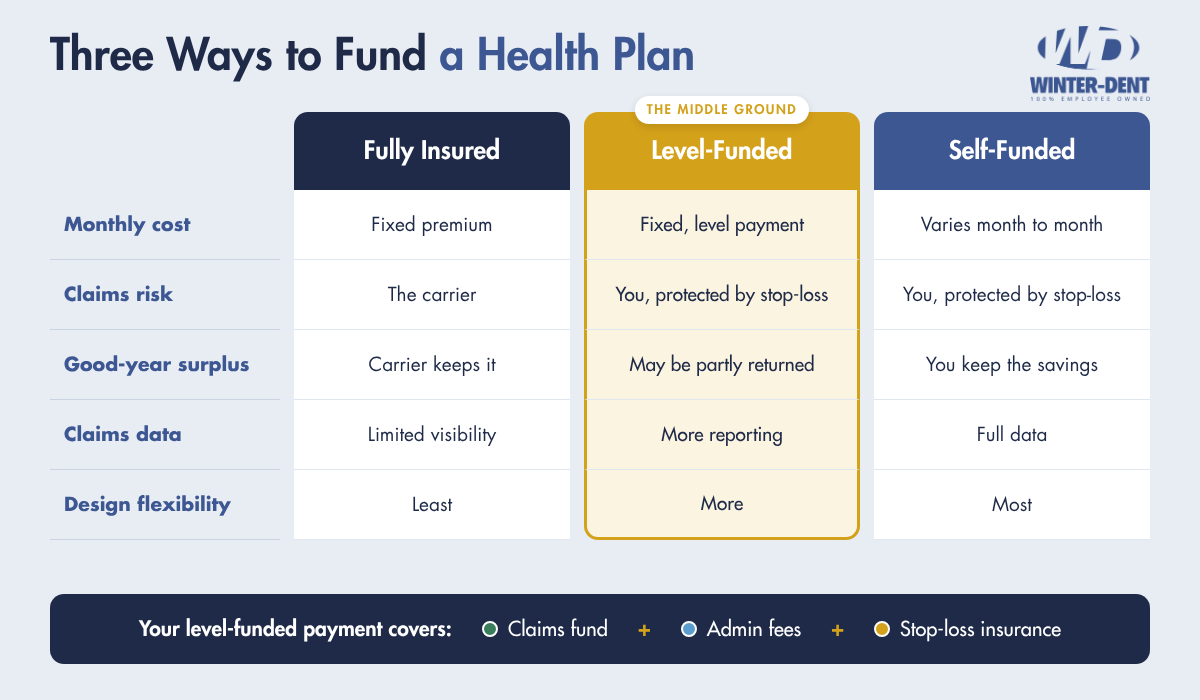
Fully insured. You pay a fixed monthly premium to a carrier. The carrier pays the claims and keeps the risk, along with any money left over when claims come in lower than expected. Your costs are predictable within the year, but you have limited visibility into what drives them.
Self-funded. You pay employees' claims as they occur, usually through a third-party administrator, and buy stop-loss insurance to protect against very large claims. You gain flexibility and data, and you keep the savings in a good year. You also take on more month-to-month variability.
Level-funded. You pay a level monthly amount, much like a premium, that is divided into three parts:
- A claims fund set aside to pay your employees' expected claims
- Administrative fees for the administrator, network and services
- Stop-loss insurance that protects you if claims are higher than expected
If claims come in lower than the claims fund for the year, some contracts return a portion of the surplus or apply it as a credit. If claims run higher, stop-loss coverage steps in, so your monthly cost stays the same for that plan year.
Why employers consider level-funding
Predictable monthly cost. Your payment is level for the year, which makes budgeting easier than traditional self-funding.
Potential to share in a good year. Depending on the contract, a healthier-than-expected year may mean money back, something a fully insured plan generally does not offer.
Better data. Level-funded plans typically provide more claims reporting than small fully insured plans. That data can help you understand what is driving costs and make better design decisions.
More design flexibility. Because level-funded plans are a form of self-funding, they may be exempt from some state insurance mandates and premium taxes, which can give employers more room to tailor the plan.
Who level-funding may fit

Level-funding tends to work best for employers who have:
- Roughly 50 to 200 employees, where it is often strongest at 50 to 100
- A relatively stable workforce without frequent large swings in headcount
- Claims that are steady or better than average, since level-funded pricing is usually underwritten on your group's health profile
- Enough financial stability to handle a transition and plan for the long term
- Interest in using data to manage the plan during the year, not just at renewal
Who it may not fit
Level-funding is not right for everyone. It may be a harder fit if:
- Your group has known large ongoing claims. Underwriting may price them in, or stop-loss may limit coverage for them.
- Your workforce is very small or changes often, which can make claims more volatile.
- You want the simplest possible arrangement and do not plan to use the data or adjust the plan.
In some cases, staying fully insured is the right answer. In others, a healthcare captive, where similar-sized employers share a layer of risk, may be worth evaluating. The point is to compare options with real numbers, not assumptions.
Questions to ask before you switch
Level-funded contracts can differ a great deal. Before you sign, ask:
- How is surplus handled? Is unused claims money refunded, credited or kept? What percentage, and when?
- What are the stop-loss terms? What are the specific and aggregate attachment points, and are any people or conditions excluded?
- What happens if we leave? Is there coverage for claims incurred during the plan year but paid after it ends (run-out)?
- How are renewals priced? Are there caps on renewal increases, or could one bad year reset the price?
- What network and pharmacy arrangement come with the plan? How are prescription drugs, including GLP-1 medications and specialty drugs, handled?
- What reporting will we receive, and how often?
- Who will help us read the data and act on it during the year?
Connecting it to 2027
Level-funding is not a fix for rising costs on its own. Its value comes from what you do with it: using claims data to understand what is driving spend, adjusting plan design, managing pharmacy costs and supporting employees in using preventive and primary care.
That is also why timing matters. If you are considering a change for 2027, a review 90 to 120 days before renewal gives you time to gather data, compare quotes and communicate with employees.
How Winter-Dent approaches funding decisions
Our approach is to explain first and recommend second. A Winter-Dent benefits review happens in two steps:
Step 1: We review your current plan: costs, claims, design, contributions and how employees use it.
Step 2: We use that analysis to compare options, which may include staying fully insured, moving to a level-funded plan, self-funding or evaluating a healthcare captive where the fit is right.
There is no cost for the review, and you leave with a clearer view of your options either way.

Coming December 7: the Winter-Dent Employee Benefits Assessment, a short online form that returns a Benefits Opportunity Snapshot. It is a quick way to see whether alternative funding is worth a closer look.
The Prevent365 view
Prevent365 is Winter-Dent's philosophy across every line: prevent what you can, contain what you can't and insure only what truly can't be controlled. In benefits, funding strategy is one of the most important places to apply it. When you can see your data and manage the plan all year, you have more control over what happens at renewal.
Frequently asked questions
What is a level-funded health plan?
A level-funded plan is a form of self-funding with a fixed monthly payment. The payment covers a claims fund, administrative fees and stop-loss insurance. Depending on the contract, unused claims funds may be partly returned at the end of the year.
What is the difference between level-funded and fully insured?
With a fully insured plan, the carrier keeps the claims risk and any surplus. With a level-funded plan, the employer funds expected claims, is protected by stop-loss insurance and may share in surplus if claims run lower than expected.
What size company is level-funding best for?
Level-funding is often a fit for employers with roughly 50 to 200 employees, and it tends to be strongest for groups of 50 to 100 with a stable workforce.
Can a level-funded plan save money?
It can, depending on your group's claims, the contract terms and how actively the plan is managed. Results vary, so it is important to compare level-funded quotes against your current plan using your own data.
What happens if claims are higher than expected?
Stop-loss insurance helps cover claims above set limits, so your monthly payment stays level for the plan year. Higher claims may affect your renewal pricing.