

Five scenarios that show how cyber claims actually break down, and what proactive businesses do differently.
The conversation about cyber risk gets easier when it stops being theoretical. Most business leaders we work with have heard the statistics. They have read the breach headlines. What they have not seen is what happens after the event, when the insurance policy meets the operational reality and the gap becomes a number on a balance sheet.
This article walks through five anonymized scenarios. None of them are unusual. Each pattern shows up multiple times a year in the small and mid-sized business market. The names, industries, and figures have been removed or altered to protect identity. The lessons are real, and they all point to the same conclusion: coverage rarely fails because the event was excluded. It fails because of a control, a process, or an attestation that no one verified before the policy was needed.
Here is what happens.
Scenario 1: The Vendor Wire That Disappeared
A small services firm received an email that appeared to come from a long-time vendor. The email confirmed an active project, referenced an open invoice, and provided updated banking instructions for an upcoming payment. The accounting team verified the email address against prior correspondence, matched the invoice to a real obligation, and processed the wire.
The email was not from the vendor. A threat actor had compromised the vendor's email account weeks earlier, studied the project relationship and payment cadence, and inserted spoofed instructions into a legitimate reply chain. The wire cleared into an account that was emptied within hours.
Why the claim failed:
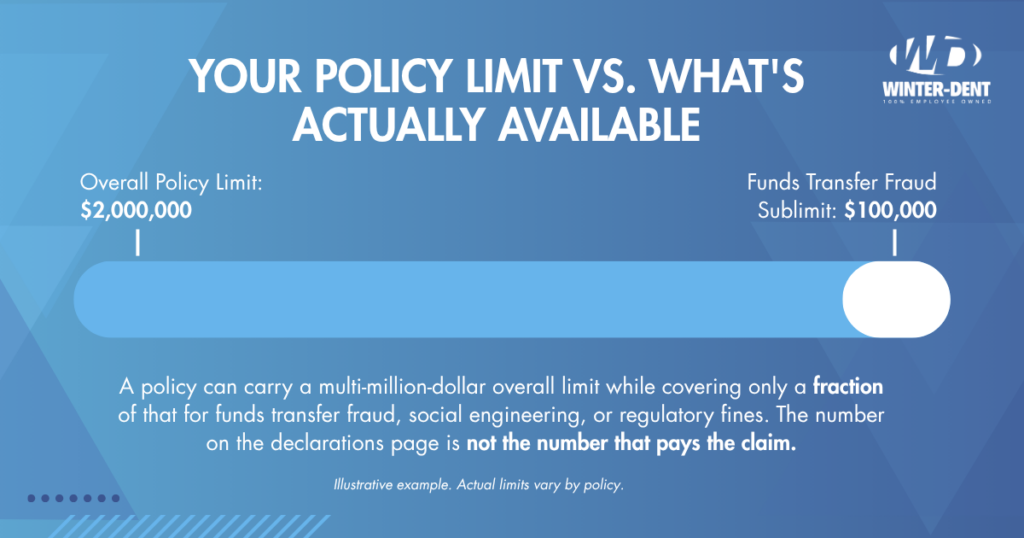
- The funds transfer fraud sublimit was a fraction of the overall policy limit.
- The policy required documented callback verification of any banking change. The internal process was informal and could not be substantiated.
- The carrier's forensic review identified inconsistencies between application attestations and the controls actually in place.
What proactive businesses do differently: They treat any banking change as a high-friction event. Callback verification is mandatory, documented, and audited. Vendor payment protocols are written down, reviewed annually, and tied to specific controls the cyber policy requires.
Why do cyber insurance claims for wire fraud often get denied or reduced?
Cyber claims involving wire fraud typically fail for one of three reasons: the loss exceeds the funds transfer fraud sublimit, the insured cannot prove required verification procedures were followed, or controls attested to on the application were not actually in place. Documented callback verification and dual controls are the most common preventable gaps.
Scenario 2: The Ransomware Event That Took 14 Days to Resolve
A mid-sized manufacturer was hit with ransomware that encrypted production systems, the file server, and the backup environment. Operations stopped. The carrier was notified within hours. Incident response, forensic, and legal counsel were engaged through the cyber policy.
The carrier eventually paid for incident response, the ransom negotiation, and a portion of the business interruption loss. The remaining gap, which the business absorbed, came from three places.
Why the claim was incomplete:
- Backups were not segmented from the production network and were encrypted along with everything else. The business interruption period extended from a recoverable two days to a painful fourteen days.
- The business interruption waiting period and coinsurance provisions limited recovery to a fraction of the actual operating loss.
- The incident response plan existed on paper but had never been tested. Decisions that should have taken hours took days.
What proactive businesses do differently: They segment backups from production, test restoration regularly, and run tabletop exercises on their incident response plan at least annually. They review business interruption terms with their broker before signing, not after a claim.
Scenario 3: The MFA Gap No One Knew Existed
A professional services firm filed a claim after an executive's email account was compromised and used to send fraudulent invoices to a key client. The client paid one of the invoices before the fraud was detected. The firm filed a claim under both its cyber policy and its crime policy.
The cyber renewal application, signed by an executive, attested that multi-factor authentication was enabled across the entire email environment. The carrier's forensic review found that MFA had been enabled for most accounts, but a small group of legacy accounts, including the compromised executive's mobile email access, had been left out of the rollout.
Why the claim was denied:
- The attestation on the application did not match the controls in place at the time of the loss.
- The IT provider had not communicated the legacy access exception to leadership, and leadership had not asked.
- The carrier concluded that the misrepresentation was material to the underwriting decision.
What proactive businesses do differently: They verify controls before they attest to them. MFA coverage is documented account by account, not assumed. The executive signing the application asks for and reviews the underlying evidence.
What is a cyber insurance attestation, and why does it matter?
A cyber insurance attestation is a sworn statement, signed by an executive, confirming that the controls described on the renewal application are accurate and in place. At claim time, carriers verify whether the attested controls existed at the moment of the incident. Inaccurate attestations, even unintentional ones, can void coverage and create personal exposure for the signer.
Scenario 4: The Phishing Loss That Was Not Really About Phishing
A regional firm lost a meaningful sum after an accounts payable clerk responded to a phishing email and forwarded credentials to what appeared to be the bank. The threat actor used the credentials to access the online banking portal, change account settings, and initiate outbound transfers over several days before the activity was detected.
The cyber policy paid a portion of the loss, but the carrier reduced recovery based on two findings.
Why the claim was partial:
- The employee had not completed phishing awareness training in over two years, which the application had implied was current.
- The bank account did not have dual control authorization enabled for transfers above a threshold the policy explicitly required.
- The phishing email had bypassed email filters because basic email authentication (SPF, DKIM, DMARC) had not been fully implemented.
What proactive businesses do differently: They treat phishing training as a documented, recurring program, not a one-time event. They verify with the bank that dual controls are enabled. They confirm with their IT vendor that email authentication is configured and working.
Scenario 5: The Customer Data Breach That Triggered Regulatory Response
A healthcare-adjacent business experienced a breach of customer records through a third-party application vulnerability. The number of affected records exceeded notification thresholds in multiple states. The cyber policy responded to forensic investigation, legal counsel, customer notification, and credit monitoring. The carrier did not cover the full regulatory penalty exposure.
Why the coverage gap appeared:
- Regulatory fines were heavily sublimited under the cyber policy, with the sublimit far below the actual fine exposure.
- The state notification timeline was shorter than the response timeline the business actually executed, creating additional regulatory exposure.
- The third-party application vendor's contract did not include indemnification language that would have shifted some of the loss back to the source of the vulnerability.
What proactive businesses do differently: They review regulatory sublimits against their actual data exposure annually. They map state notification timelines into their incident response plan. They review vendor contracts for indemnification, data handling, and breach notification clauses.
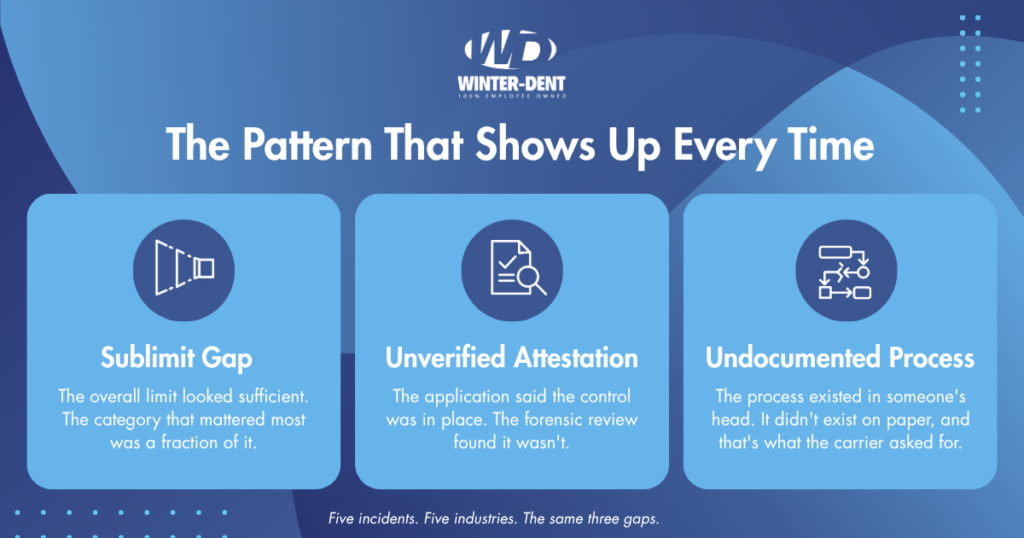
The Pattern That Shows Up Every Time
Five different events. Five different industries. The same three failures, in different combinations:
- A sublimit that was smaller than the overall policy implied
- A control that was attested to but not verified
- A process that existed in concept but not in practice
This is the underwriting reality of the current cyber market. Carriers are not trying to deny claims. They are enforcing the terms that have always been there but rarely mattered until the loss ratios forced them to. The businesses that get full recoveries are not luckier. They are more prepared.
What Most Businesses Do vs. What Proactive Businesses Do
| Reactive Approach | Proactive Approach |
| Buys cyber coverage based on overall limit | Reviews sublimits against most likely loss scenarios |
| Signs the renewal application from memory | Verifies controls account by account before attesting |
| Treats incident response as an IT process | Tests incident response with leadership annually |
| Assumes vendor contracts protect them | Reviews vendor contracts for indemnification and breach terms |
| Discovers gaps during a claim | Discovers gaps during an assessment |
What is the most common reason cyber claims get partially paid instead of fully paid?
The most common cause of a partial cyber claim is a category sublimit. A business may carry a multi-million-dollar overall limit but only have a fraction of that available for funds transfer fraud, social engineering, regulatory fines, or business interruption. Reviewing sublimits against likely loss scenarios is one of the highest-leverage actions in any cyber coverage review.
The Strategic Insight Most Brokers Skip
Every one of these scenarios was preventable. Not the event itself, but the coverage gap. In each case, a structured pre-renewal review would have surfaced the issue before it became a loss. A documented control verification would have prevented the attestation problem. A simple read-through of the policy schedule with the broker would have identified the sublimit.
This is the work the cyber market now requires. It is not about buying more insurance. It is about making sure the insurance you already have will actually pay when something happens, and that the operation behind it is documented well enough to defend the claim.
The companies that learn this lesson from someone else's incident pay far less than the companies that learn it from their own.
How Winter-Dent Approaches Cyber Risk
Winter-Dent treats cyber the way we treat every other commercial risk: as something to diagnose, differentiate, reduce, and only then insure. Our Prevent365 methodology applies four steps to cyber exposure.
Diagnose. We start with a complimentary external rating. The findings tell us where attackers and underwriters are likely to focus. A full assessment goes deeper into internal controls, vendor exposure, and incident response readiness.
Differentiate. We build a clean, documented submission with verified controls and a strong external rating. Underwriters reward preparation with better terms.
Reduce. We coordinate with your existing IT provider to close the gaps that matter most. We do not sell software or replace your IT vendor.
Insure. Coverage is structured around what your business actually faces, with sublimits, retentions, and endorsements that reflect real exposure. Attestations are signed with confidence because the answers are documented and verifiable.
Cyber coverage works best when it is the last line of defense, not the first.
What to Do Before Your Next Cyber Event
If your renewal is on the horizon, or if any of the scenarios above feel uncomfortably familiar, the highest-leverage thing you can do this quarter is talk to your Winter-Dent advisor about your current policy schedule, including category sublimits and where your business stands against the kind of external scan carriers and threat actors run.
Go Deeper with a Full Third-Party Security Evaluation
For businesses preparing for a major renewal, responding to a prior loss, or operating in industries where carriers are demanding more documented evidence, Winter-Dent also offers a comprehensive third-party security evaluation through a vetted compliance partner.
The evaluation builds the internal foundation carriers expect to see:
- Written compliance policies tailored to your business and aligned with regulatory expectations.
- Employee compliance training through a managed learning system, with documented completion records.
- Task monitoring and documentation to prove controls are not just in place, but maintained and auditable.
- Cyber insurance alignment so coverage, controls, and policy language actually match the exposure.
- IT and technology vetting through a vetted national network, with no obligation to switch providers.
The result is a defensible, well-documented cyber posture that strengthens the underwriting submission, reduces claim denial risk, and gives leadership a clear record of diligence.
Talk to your Winter-Dent advisor first to determine whether your business is a fit for the full evaluation, or contact Winter-Dent directly at info@winter-dent.com to learn more.
Frequently Asked Questions About Cyber Incidents
What is the most common reason a cyber insurance claim gets denied?
The leading reasons are unmet control requirements (such as missing MFA), inaccurate attestations on the renewal application, exceeded category sublimits, and undocumented processes such as callback verification on wire transfers. Claims are rarely denied because the event itself was excluded. They are reduced or denied because a control, attestation, or process did not match what the policy required.
Are cyber insurance claim denials becoming more common?
Yes. The cyber market sustained heavy losses between 2018 and 2022, which forced carriers to tighten underwriting and enforce policy conditions more rigorously at claim time. Forensic reviews are now standard. Carriers verify controls against what was attested on the application, and meaningful gaps can result in reduced payouts or denied claims even when the underlying event is otherwise covered.
What is the difference between a cyber claim being denied and being reduced?
A denied claim means the carrier has determined no coverage applies, often due to a material misrepresentation, an unmet condition, or a clear exclusion. A reduced claim means coverage applies but the payout is limited, typically by a sublimit, coinsurance, retention, or partial application of an exclusion. Reduced claims are more common than full denials, and the financial impact can still be substantial.
Can a business challenge a denied cyber claim?
Yes, and businesses sometimes recover additional amounts through negotiation, mediation, or litigation. However, the strongest leverage at the time of a claim is documentation: evidence that controls were in place, attestations were accurate, processes were followed, and the loss falls within covered terms. Building that evidence after the loss is far harder than building it before.
How do I know if my current cyber policy would actually pay in a real incident?
The most reliable way is a pre-loss review of the policy schedule alongside an honest assessment of current controls and processes. The review should map likely loss scenarios (wire fraud, ransomware, data breach) against specific policy provisions including sublimits, retentions, control requirements, and process conditions. Most businesses discover meaningful gaps in this review.