
Risk management for small business is a simple, repeatable process for catching risks early and reducing them, not just an insurance policy that pays for damage after something goes wrong. Winter-Dent's Prevent365 approach breaks this into four steps, so your protection keeps up as your business grows instead of falling behind it.
Most small business owners don't have a problem because they lack insurance. They have a problem because their business changed and their coverage didn't. A policy that made sense for a five-person shop often doesn't fit the same company once it has twenty employees, a second location, or bigger clients. That gap, between where your business is today and what your policy was built to cover, is where real financial risk lives.
That's the problem Prevent365 is built to solve. It isn't a policy. It's a simple, year-round way of managing risk as your business changes, built around four steps: Diagnose the Root Cause, Differentiate Your Business, Go Beyond the Policy, and Build for Impact.
Why Small Business Insurance Falls Behind
Most people buy insurance once and then don't think about it again until renewal. But your business doesn't wait for renewal to change. Hire a new employee, and your workers' comp and HR-related risk change that same day, not on your policy's renewal date. Land a bigger contract, and the client may require higher coverage limits before your next scheduled review even happens. Open a second location, and your property risk changes right away too.
The result is a gap between your business and your coverage that most owners never notice, because it doesn't feel urgent until a claim, a lawsuit, or a lost contract makes it urgent all at once.
What a Risk Management Framework Actually Does
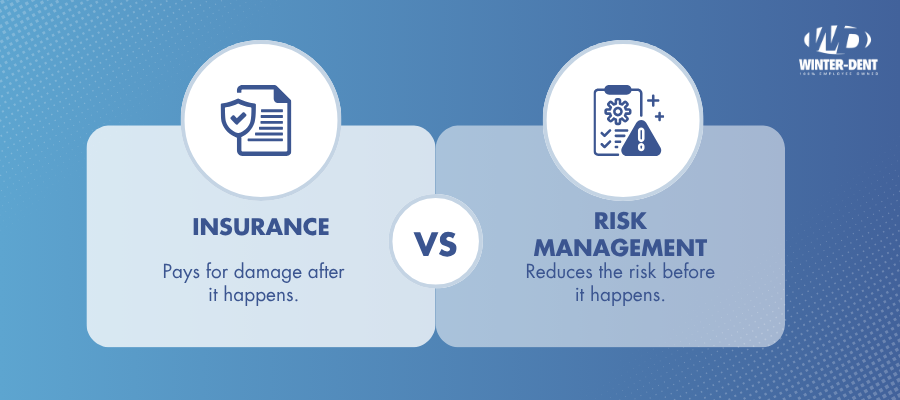
A risk management framework does three things a policy alone can't: it catches problems before they cause a loss, it documents the safety habits that affect what you pay for insurance, and it sets a regular schedule for checking your coverage as your business changes. Insurance pays for damage after it happens. A framework helps you avoid the damage in the first place.
That difference matters more than most owners realize. Insurance is what pays out after a covered loss happens. Risk management is what lowers how often those losses happen, and how bad they are, in the first place. Businesses that only buy insurance pay for protection. Businesses that also manage their risk pay less for better protection, because insurance companies look at more than just what industry you're in. Your claims history and your safety habits both affect your price.
Prevent365: A Framework Built for How Small Businesses Actually Grow
Prevent365 is Winter-Dent's year-round way of managing risk alongside your business, broken into four steps.
Diagnose the Root Cause
Before we recommend any coverage, we figure out what's actually driving your risk. Two businesses in the same industry can face very different risks depending on how they operate, who their clients are, and their history. We start with your business, not a generic industry checklist.
Differentiate Your Business
Insurance companies compare your business to others like it before deciding what to charge you. A business that can show its safety habits and claims history in a clear, organized way looks different to them than one that can't. This step is about building that story so your business stands out for the right reasons.
Go Beyond the Policy
A policy is only one layer of protection. This step focuses on the everyday habits that reduce risk directly, like safety routines and making sure contracts spell out who covers what, so fewer problems happen in the first place.
Build for Impact
Managing risk isn't a one-time project. This step sets up a regular check-in, usually tied to growth milestones, so the first three steps stay current as your business keeps changing.
Each step has its own focus, but together they work as an ongoing cycle, not a checklist you finish once. A future article in this series will go deeper into each step. For now, the main point is this: Prevent365 gives small businesses a real plan, instead of the usual approach of buy a policy, file it away, and only think about it again when something forces the issue.
What Most Businesses Do vs. What Proactive Businesses Do
| Most Businesses | Proactive Businesses |
| Review coverage once a year at renewal, if at all | Review coverage at growth milestones: new hires, new locations, new contracts, new equipment |
| Treat safety habits as separate from their insurance strategy | Treat documented safety habits as part of the conversation about their coverage and price |
| Call their agent only to file a claim or request a quote | Use their advisor as an ongoing resource for risk decisions, not just a policy transaction |
| Find out coverage gaps after a loss or a lost contract | Find and close coverage gaps before they become a claim or a lost opportunity |
How Prevention Changes What You Pay for Insurance
Insurance companies don't just look at what industry you're in. Your claims history, your safety habits, and proof that you're actively managing risk all affect your price and which companies want to insure you. Businesses that can show they manage risk well usually have more options and more room to negotiate at renewal.
This is the part most articles about insurance costs miss. The usual advice is to shop around for a better rate or raise your deductible. Those things can help a little, but they don't change how your business looks to an insurance company. Managing your risk does. A business with a clear safety program, a good claims history, and proof it's actively managing risk looks like a better bet than one without any of that, even if the two businesses look the same on paper otherwise.
This is also why Winter-Dent, as an employee-owned company, builds the advisor relationship around an ongoing conversation about risk, not a once-a-year transaction. The stronger your track record, the more leverage you have at every renewal after that.
When to Revisit Your Risk Strategy
Growth milestones are the natural trigger points for a coverage review. If any of the following have happened since your last review, it is worth a conversation before renewal forces one:
- You hired employees, especially your first, fifth, or twentieth
- You signed a client contract with new insurance requirements
- You added a location, vehicle, or major piece of equipment
- Your revenue grew significantly in the last twelve months
- You expanded into a new service line or geography
- You experienced a claim, near-miss, or safety incident
Getting Started
If your business has changed in the last year and nobody has looked at your coverage since, that's worth fixing before it gets expensive. A conversation with a Winter-Dent advisor about where your business stands today, using Prevent365 as the starting point, is the fastest way to find out if your coverage still matches your risk.
The businesses that manage risk well aren't the ones with the most insurance. They're the ones whose protection was built to keep up with them.

Frequently Asked Questions
How is a risk management framework different from just having business insurance?
Insurance pays for damage after something goes wrong. A risk management framework works earlier, by spotting risks, reducing how often problems happen, and keeping a record of your safety habits that affects what insurance companies charge you. Businesses that do both usually have fewer claims and better prices than businesses that rely on insurance alone.
How often should a small business review its insurance coverage?
Once a year at renewal is the bare minimum, not the standard. Big changes like new hires, new contracts, new locations, or a jump in revenue should each trigger a review on their own, since they change your risk right away, not on your renewal schedule.
Can proactive risk management actually lower my insurance premiums?
It can help indirectly. Insurance companies look at your claims history and safety habits, not just your industry. A business that can show it actively manages risk usually looks like a better bet, which can mean better pricing and more options at renewal, though results vary by industry and company.
What is the Prevent365 methodology?
Prevent365 is Winter-Dent's year-round approach to managing risk, broken into four steps: Diagnose the Root Cause, Differentiate Your Business, Go Beyond the Policy, and Build for Impact. It's an ongoing approach, not a one-time checkup or a product you buy.
At what size does a small business need a formal risk management strategy?
There's no magic number of employees or revenue that makes this necessary. A one-person business has its own risks, mostly tied to depending entirely on the owner. A fifty-person business has more moving parts. What matters isn't your size, it's whether your protection has kept up with how your business has changed.