
A decision-stage guide for business leaders evaluating what daily life looks like inside a group captive insurance program.
The financial case for a group captive is well documented. The operational case is not. Most companies enter captive conversations focused on premium savings, underwriting profit, and dividend potential, and only later discover that captive ownership comes with a different operating rhythm than fully insured programs. The structure asks more of the company. It also gives the company more control.
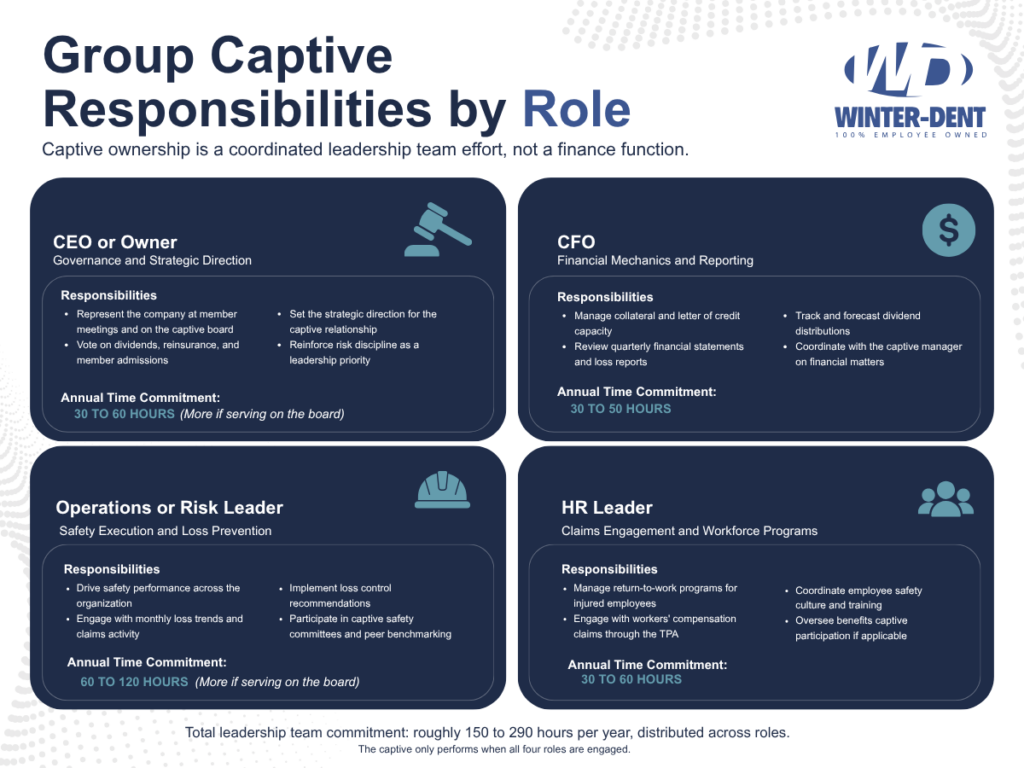
Just as importantly, captive ownership is not a finance project. It is a leadership team commitment. CEOs and owners hold the governance seat. CFOs manage the financial mechanics. Operations and risk leaders drive the safety execution that determines whether the captive performs. HR leaders own claims engagement and return-to-work programs. Each role has distinct responsibilities, and the captive only works when all of them are engaged.
This article walks through what actually changes when you move from a fully insured program to a group captive, role by role, so your leadership team can evaluate the operational reality alongside the financial one before making a commitment.
The Short Answer
In a fully insured program, the carrier owns the risk, the reserves, and the decisions. In a group captive, you and your fellow members own all three. That ownership produces real financial upside, but it also requires governance participation, internal coordination across multiple roles, multi-year commitment, and active engagement with claims, safety, and financial reporting. Group captive members who treat the structure as a strategic leadership commitment perform well. Members who delegate it to a single function tend to struggle.
What Changes in Governance and Reporting
In a fully insured program, governance is simple. You buy a policy, the carrier handles regulatory filings, financial statements, reserve setting, and reinsurance, and your only governance touchpoint is the renewal conversation.
A group captive is a regulated insurance company that you co-own with other member companies. That changes the governance picture entirely.
The captive has its own board of directors made up of member representatives, typically rotating among participating companies. The board meets several times per year and oversees underwriting decisions, dividend distributions, reinsurance placement, vendor selection, and member admissions. Each member company is expected to provide a representative, usually the CEO, owner, or another senior executive, who participates in member meetings and votes on captive matters.
Reporting is significantly more substantive than fully insured programs provide. Members typically receive:
- Monthly or quarterly loss reports
- Quarterly financial statements
- Claims activity summaries with reserve detail
- Reinsurance and aggregate stop-loss performance reports
- Investment income reports on held reserves
- Annual actuarial reviews
- Annual audited financial statements
These reports are read by different members of the leadership team for different purposes. The CFO uses them for financial planning and dividend forecasting. Operations and risk leaders use them for trend analysis and safety prioritization. HR leaders use them for claims oversight and return-to-work performance. The CEO or owner uses them for governance preparation. The expectation is not just that the company receives these reports. The expectation is that the right people read them, understand them, and act on them.
How Much More Internal Involvement Is Required
This is one of the most under-discussed aspects of captive ownership. The honest answer is that the time commitment is real, but it spreads across the leadership team rather than landing on any one person.
Here is how the workload typically distributes for a group captive member.
- CEO or owner. Two to four member meetings per year, generally two days each. Board participation if elected as a member representative. Final authority on strategic decisions about the captive relationship. Roughly 30 to 60 hours per year for an active participant, more if serving on the board.
- CFO. Quarterly financial review and reporting cycles. Collateral and letter of credit management. Dividend tracking and forecasting. Coordination with the captive manager on financial matters. Roughly 30 to 50 hours per year.
- Operations or risk leader. Monthly engagement with loss trends, safety performance, and claims activity. Participation in captive safety committees or working groups. Implementation of loss control recommendations. This is often the heaviest internal commitment, ranging from 60 to 120 hours per year, because operational discipline is where captive performance is actually made.
- HR leader. Claims engagement, return-to-work program management, and (for medical stop-loss captives) plan oversight. Coordination with the TPA on workers' compensation claims. Roughly 30 to 60 hours per year, more if employee benefits are part of the captive structure.
The total leadership commitment is meaningful but distributed. No single role is overwhelmed if the work is properly assigned. The companies that struggle are the ones that try to push all of it onto one function, usually finance or HR, rather than treating it as a coordinated team responsibility.
The captive manager handles the regulated insurance company operations, including domicile compliance, financial reporting, and regulatory filings. The member's job is to participate in governance, manage their own loss experience, and engage with peers across the right roles.
What Board Oversight Actually Looks Like
Board oversight is the operational element most foreign to fully insured companies, so it is worth describing concretely.
A group captive board typically meets two to four times per year, often in connection with member meetings. The agenda usually includes:
- Financial performance review covering loss ratios, reserves, and investment returns
- Reinsurance program review and renewal
- Member admissions and exits
- Dividend declaration decisions
- Safety and claims trend analysis
- Vendor performance review for the captive manager, TPA, actuary, and auditor
- Strategic direction for the captive program
Board representation typically falls to the CEO, owner, or a designated senior executive. The role is governance, not technical. Board members are not expected to be insurance experts. They are expected to bring business judgment, financial discipline, and strategic perspective to decisions made on behalf of the membership.
Member representatives are expected to come prepared, having read board materials in advance, with input from their internal team. The CFO typically prepares the financial perspective. The operations or risk leader prepares the loss and safety perspective. The board representative carries that consolidated perspective into the meeting and reports back what was decided.
The practical implication is that captive ownership requires executive bandwidth for governance, supported by coordinated input from across the leadership team. Members who treat governance as a solo function, or who delegate it downward without the supporting team engagement, tend to underperform.
Who Makes Decisions During the Policy Year
In a fully insured program, decision-making during the policy year is minimal. The carrier handles claims, applies policy terms, and you have limited influence on outcomes beyond reporting losses promptly.
In a group captive, decision-making is continuous and active, and it is distributed across roles.
- Claims management decisions. Group captives engage third-party administrators to handle claims, but the captive sets the claims philosophy and oversees execution. Reserve adequacy, settlement strategy, litigation management, and return-to-work programs are reviewed with active member input, often through a claims committee. The HR leader and operations leader are typically the most engaged on individual claims, with the CFO involved on financial reserve decisions and the CEO involved on significant litigation matters.
- Safety and risk control decisions. Group captives invest in safety and loss prevention because every dollar of avoided loss flows back to ownership through underwriting profit. Decisions about training programs, equipment investment, telematics, and process changes are tied directly to captive performance. The operations or risk leader typically owns these decisions day-to-day, with HR involvement on workforce-related programs and CEO involvement on capital investments. Most group captives provide shared safety resources, peer benchmarking, and loss control consulting that members are expected to actively use.
- Financial decisions. Investment of held reserves, collateral structuring, and dividend timing are board-level decisions made on behalf of the membership. The CFO is the primary internal stakeholder, with the CEO or owner participating through board representation.
- Underwriting decisions. New member admissions, coverage adjustments, and reinsurance placement are ongoing decisions made throughout the year. These typically sit with the board and the captive manager, with CEO or owner involvement through governance.
- Workforce and benefits decisions. For captives that include workers' compensation or employee benefits, HR leaders make ongoing decisions about return-to-work, claim engagement, wellness programs, and (for medical stop-loss) plan design. These decisions directly affect captive performance and are not delegable to a TPA.
The practical effect is that risk management becomes a year-round operational discipline distributed across the leadership team, rather than a renewal-season exercise owned by one function. This is the single biggest operational shift fully insured companies experience when joining a group captive.
What Most Companies Expect vs. What Actually Happens
| What Most Companies Expect | What Actually Happens |
| Captive ownership feels like fully insured with better economics | Captive ownership requires year-round engagement and governance participation |
| The captive manager handles everything | The captive manager handles administration; members handle their own risk and governance |
| Claims are someone else's problem | Claims management is a shared responsibility across HR, operations, and finance, with TPA support |
| Safety is an HR or operations checkbox | Safety is a financial discipline tied directly to underwriting profit |
| The CFO will handle the captive | The captive is a leadership team commitment, not a finance project |
| Renewal is the main touchpoint | Quarterly reporting, member meetings, and claims reviews are continuous touchpoints |
| Exit is a one-year decision | Exit involves runoff obligations on prior loss years and follows defined captive provisions |
The companies that thrive in group captives recalibrate their expectations on day one. They do not try to operate the captive like a fully insured program with better terms, and they do not try to assign it to a single function.
What Happens If We Want to Exit
This is the question most companies do not ask early enough, and it deserves a direct answer.
Group captives are designed for multi-year commitment. The financial structure assumes members are participating long enough for loss development, investment income, and dividend cycles to play out. Exit is permitted, but it carries operational and financial implications that fully insured exits do not.
- Notice and timing. Most group captives require advance written notice, typically six to twelve months, before the exit can take effect at a captive renewal date. You cannot exit mid-policy year.
- Runoff obligations. When you exit, you do not walk away from prior loss years. The losses incurred during your years of membership continue to develop, sometimes for years afterward. Your share of those losses, your collateral against them, and your eligibility for future dividends from those years all remain tied to the captive until those years are fully developed and closed. This is called runoff, and it can extend three to seven years after exit depending on the line of business.
- Collateral release. Your collateral, typically held as a letter of credit, is released gradually as prior years close out. It is not returned in a single payment when you exit. Most members see meaningful collateral release within two to four years of exit, with full release after all prior years close.
- Dividend eligibility. You generally remain eligible for dividends declared on the years during which you were a member, even after exit. Future-year dividends do not apply to former members.
- Return to the standard market. When you exit, your loss history follows you. The good news is that companies that have used captive participation to drive genuine loss reduction typically return to the standard market in a stronger underwriting position than they left it. The captive years often become a competitive advantage at the next renewal.
The right framing for exit is not "can we leave if it doesn't work" but "are we prepared to commit for the time horizon the structure assumes." Companies that join group captives expecting to evaluate after one or two years are usually disappointed, because the financial and operational benefits compound over five to seven year cycles.
Strategic Insight: The Operational Shift That Determines Success
The companies that perform inside group captives share an operational pattern that distinguishes them from those that struggle.
They treat captive participation as a leadership team responsibility, not a delegated function. The CEO or owner shows up at member meetings prepared and engaged. The CFO integrates captive reporting into the regular financial cadence. The operations or risk leader treats safety performance as a financial discipline. The HR leader actively manages return-to-work and claims engagement. The four roles coordinate, share information, and reinforce one another.
The companies that struggle assign the captive to a single function and walk away. Reports go unread by the people who could act on them. Member meetings are delegated to someone without authority to commit. Claims are handed to the TPA without internal engagement. Safety remains a checkbox owned by no one in particular. Within two to three years, the financial benefits the structure was supposed to deliver have not materialized, and the company assumes the captive failed.
The captive did not fail. The operating model never adjusted, and the leadership team never committed to the work the structure assumed.
The strategic question is not whether your company can afford the captive's capital and collateral commitment. It is whether your leadership team is prepared to operate at the rhythm the captive requires.
The Difference Between Joining a Captive and Performing in One
A group captive is a structure. The performance comes from the operating discipline behind it, distributed across the leadership team. That distinction is where most companies underestimate what changes operationally.
Winter-Dent's Prevent365 methodology is built for the year-round cadence a captive requires. It is not a captive product, and it is not a renewal-season exercise. It is the ongoing risk management model we apply to client risk so the company's loss experience, underwriting profile, and financial exposure all move in the right direction over time. It engages the right roles in the right work. That model is what produces the operational discipline a captive rewards.
The methodology operates in four parts.
Diagnose the Root Cause. We go beyond symptoms to uncover what is really driving risk in your business, so you can take corrective action where it matters most. Inside a captive, this means identifying the loss drivers that are quietly consuming underwriting profit before they show up in dividend calculations, and bringing the right roles into the conversation to address them.
Differentiate Your Business. We help you stand out to underwriters by showcasing what makes your business a better-than-average risk, improving pricing, terms, and market access. Inside a captive, this becomes the foundation for how you are positioned at renewal, both within the captive and if you ever return to the standard market.
Go Beyond the Policy. From safety initiatives to process improvements, we help you put controls in place that reduce risk where insurance cannot reach. Inside a captive, this is the work that determines whether the structure returns underwriting profit or absorbs preventable losses, and it engages operations, HR, and ownership in coordinated execution.
Build for Impact. We guide decisions that align with your values and your vision, creating a more resilient business that is protected for years to come. Inside a captive, this is the multi-year discipline that compounds into the financial outcomes captive ownership is designed to deliver.
The operational shift from fully insured to captive is real, and it lands on the entire leadership team. The companies that make it successfully have a risk management model built for the rhythm. Prevent365 is the model Winter-Dent uses to make that happen.
Frequently Asked Questions
Who in our company should attend group captive member meetings?
Most member companies send their CEO or owner, often accompanied by the CFO, operations leader, or risk manager depending on the meeting agenda. Member meetings include both governance content (best suited to senior leadership with decision authority) and operational content like safety, claims, and loss trends (best suited to operations and HR leaders). The most engaged members rotate attendance based on the topics covered each meeting.
Can our existing broker work with us if we join a group captive?
It depends on the captive's structure. Many group captives work with a defined network of broker partners who are familiar with captive operations and have been approved by the captive's board. If your current broker does not have group captive experience or an existing relationship with the captive, you may need to either change brokers or have your broker apply for approval. Captive-experienced brokers add significant value during member onboarding and ongoing operations.
What happens to our claims if we exit the group captive?
Claims incurred during your years of membership continue to be administered by the captive's TPA through their full development. You do not take prior captive claims back to a new carrier when you exit. New claims after your exit date are handled by whichever program you move to. Your collateral remains posted against the prior years until those claims close, which can take three to seven years depending on the line of business.
Is a group captive better suited to certain industries than others?
Group captives perform best in industries where loss frequency and severity respond to operational discipline, particularly construction, manufacturing, transportation, distribution, and service-based businesses with workers' compensation and auto exposures. Industries with highly volatile or catastrophic loss profiles, or those dependent on specialized coverage forms, are often less suitable. Most established group captives focus on specific industry niches or risk profiles where peer benchmarking and shared safety resources add the most value.
How do dividends and underwriting profit actually flow back to members?
Dividends are typically declared by the captive's board after each policy year is sufficiently developed, usually 18 to 36 months after the year ends. They are paid based on each member's share of underwriting profit for that year, adjusted for individual loss experience. Investment income on held reserves typically flows through the same mechanism. Most members see their first meaningful dividend distributions in years three through five of membership, with continued distributions on prior years for several years afterward.