

If you've just received an audit notice from your carrier, the most useful thing to understand is that most of what determines the outcome has already happened. An audit isn't really an examination of your payroll, it's an examination of your recordkeeping, and by the time the request lands the records either exist or they don't.
That isn't cause for alarm, since most audits are routine and a fair number produce a refund rather than a bill. But it does explain something about who sails through them. The businesses that come out clean generally aren't the ones who prepared well in the final two weeks, they're the ones who happened to be collecting certificates and tracking classifications all year without thinking much about it.
So before getting into how to prepare, it helps to know what the process actually is.
What Is a Workers' Compensation Audit?
A workers' comp audit is a review your carrier conducts at the end of each policy period to compare the payroll you estimated against what you actually paid. Because premium is based on payroll and classification, the audit adjusts your premium and issues either a bill or a refund.
Every workers' comp policy is built this way. You're quoted on estimated payroll at the start of the year, and since nobody knows in January what payroll will look like in December, the audit exists to true it up afterward. Which is why an audit notice isn't triggered by suspicion and doesn't mean anyone thinks you've done something wrong.
How that review gets conducted depends mostly on your premium size and how complicated your account is. Mail and online audits ask you to submit records yourself and are the most common for smaller policies. Telephone audits add a conversation with an auditor who walks through the records with you. Physical audits put someone in your office reviewing documents directly, which tends to happen on larger premiums or where something in the file needs sorting out in person.
Whichever format you get, the request list is roughly the same.

What the Auditor Will Ask For
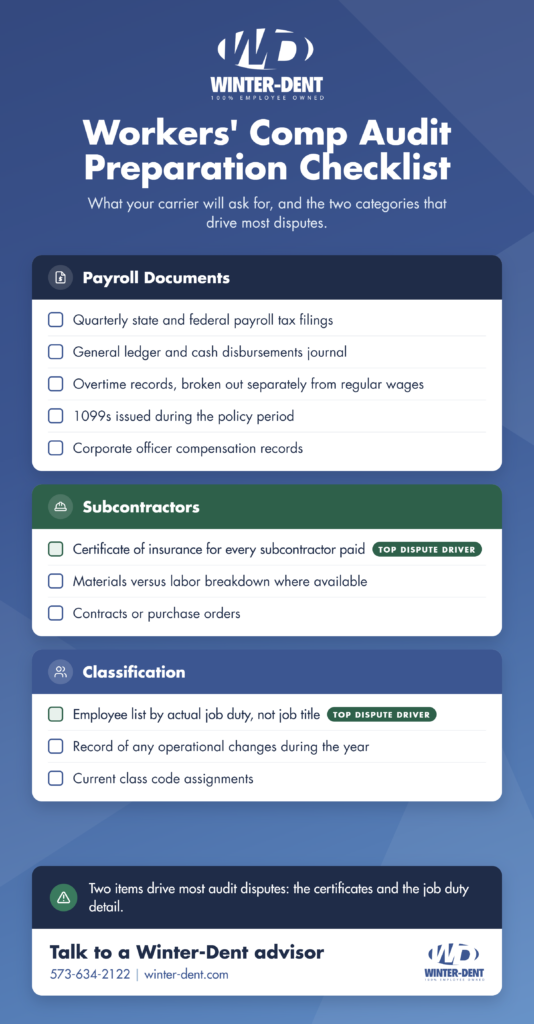
Carriers are fairly consistent here. Expect to provide payroll records including your quarterly state and federal tax filings, your general ledger and cash disbursements journal, a list of employees organized by what they actually do rather than by job title, overtime records broken out separately from regular wages, certificates of insurance for every subcontractor you paid, any 1099s issued during the period, corporate officer compensation, and a record of operational changes during the year.
Most of that is straightforward to pull together. But two items on the list account for the large majority of audit disputes, so they're worth going through carefully before the rest.
Subcontractors and Certificates of Insurance
The first of those two, and the source of most surprise bills, is the certificate file.
If you paid a subcontractor who couldn't prove they carried workers' comp coverage, their payments are typically charged back to your policy as though they were your employees. One missing certificate on a large subcontractor can add more premium than every other audit adjustment combined.
That sounds harsh until you look at it from the carrier's side, at which point the logic is hard to argue with. Workers' compensation exists so an injured worker has coverage available, so if your subcontractor had no policy and one of their people got hurt on your job, your policy is what would have responded. You carried that exposure for the length of the job, and the carrier charges you for it whether or not anyone actually got hurt.
What turns this from a technicality into a real expense is how the chargeback gets calculated. It's generally applied to the full amount you paid the subcontractor rather than just the labor portion, unless you can document a materials breakdown from the invoices. On top of that, it's rated at the subcontractor's classification rather than your own, and for many trades that rate runs considerably higher. Because it applies retroactively, collecting a certificate after the audit usually doesn't undo any of it, and since the added payroll flows into your history, it affects your pricing in future years too.
Missouri construction employers should pay closer attention here than most, because the state requires construction employers to carry coverage at one employee rather than the five that applies elsewhere. That threshold catches a lot of small subcontractors who assumed they were exempt, and the general contractor is usually the one who finds out at audit.
Sitting underneath all of this is a broader question about whether a given person is an employee or a contractor at all. On that, Missouri uses the IRS 20-factor test as its guide, and the state is direct that the substance of the working relationship governs rather than whatever the paperwork calls it. Which means paying someone on a 1099 does not, by itself, make them a contractor.
The remedy for all of it is unglamorous but reliable: collect the certificate before the first payment goes out rather than after the job wraps, track the expiration dates, and re-collect when policies renew. Businesses that keep up with that rarely get surprised, and the ones that don't tend to get surprised every few years.
Payroll You May Not Owe Premium On
Since that section was about what gets added, it's worth spending equal time on what should be coming off, because audits genuinely do run in both directions and a fair number of employers report more payroll than they owe premium on.
The rules here come from NCCI, which governs in Missouri and most other states, and they exclude or limit several categories of compensation. The Basic Manual's premium and payroll rules cover the specifics in full, but a few come up often enough to be worth knowing by heart.
Overtime is the one that costs employers the most. Only the premium portion is excludable, not the full overtime wage, so if someone's regular rate is $20 an hour and overtime pays $30, the $10 difference comes out while the $20 stays in. The catch is that claiming it requires overtime to have been recorded separately in your payroll system during the year, and if it's buried inside gross wages there's no way to reconstruct it afterward. The deduction simply disappears.
Executive officers and owners work differently again, since they're subject to minimum and maximum payroll amounts rather than being reported at full compensation. Reporting an owner's entire salary when a cap applies is both a common error and an expensive one. Beyond those two, tips above the minimum wage offset are excluded in most states, and so are severance pay, employer retirement contributions, and business expense reimbursements substantiated by receipts.
What ties all of these together is that none of them are applied automatically. The auditor works from whatever you submit, so if your payroll arrives as a single gross figure with no breakouts, that's the figure that gets used.
Classification Errors
Alongside payroll, the other number driving your premium is your class codes, which describe what your employees actually do and carry rates that vary a great deal between them. Two kinds of errors turn up regularly.
The more common one is a stale code, where the business added an operation at some point and nobody updated the classification, leaving everyone under whatever code was assigned at binding. The other runs the opposite direction, where employees who genuinely belong in a lower-rated clerical or outside sales classification get folded into the operating code simply because the payroll system doesn't separate them.
Either one is contestable, because classification is governed by manual rules rather than auditor discretion, which means a misapplied code can be challenged with documentation of what people actually do. That documentation has to be more specific than a job title, though. It needs to describe the actual function, meaning what the person does, where they do it, and with what equipment.
What to Do If the Bill Is Wrong
Given how many places an audit can go sideways, it follows that some bills will come back wrong. You do have recourse when that happens, but not unlimited time to use it, so the sequence matters.
Start by requesting the audit worksheet rather than just the invoice, since the worksheet is what shows which payroll went to which class code and what adjustments were applied. Without it you can't really evaluate the result. Once you have it, reconcile it against your own records before paying anything, looking in particular at subcontractor chargebacks, class code assignments, officer payroll treatment, and whether overtime was broken out.
If something doesn't reconcile, put the dispute in writing to the carrier's premium audit department with the documentation that supports your position, because verbal disputes tend to evaporate. Should the carrier not resolve it, escalate through your broker, which happens to be one of the more concrete services a broker provides and one of the clearer differences between one broker and another. While that's pending, pay the undisputed portion so a billing question doesn't quietly turn into a cancellation.
The one approach with nothing to recommend it is ignoring the bill altogether, since unpaid audit premium can lead to cancellation, collections, and a record that follows you to the next carrier, none of which resolves the dispute you had in the first place.
What Most Businesses Do Versus What Prepared Businesses Do
Most of what's above comes down to a handful of habits, and the difference between businesses that dread audits and businesses that barely notice them is visible when you line those habits up side by side.
| Most businesses | Prepared businesses | |
| Subcontractor certificates | Collected when someone remembers | Collected before first payment, tracked to expiration |
| Overtime records | Included in gross payroll | Broken out separately all year |
| Class codes | Set at binding, never revisited | Reviewed when operations change |
| Job duties | Listed by title | Documented by actual function |
| Officer payroll | Reported at full salary | Reported against applicable caps |
| Audit prep | Two weeks of scrambling | Records already in the format the auditor wants |
| The bill | Paid because it's official | Reconciled against the worksheet first |
| Who reviews it | Nobody | Broker, before payment |
Nothing in that right column is difficult and none of it costs much. What the entries share is that every one of them is considerably easier to do in March than in November.
Why Preparation Has Limits
Which raises a question about all the advice out there on preparing for an audit. Most of it is perfectly sound as far as it goes: organize your records, respond promptly, make yourself available to the auditor.
Still, it's worth being honest about what preparation can and can't accomplish, because the limits are real ones. You can gather your documents and present them well, but you can't create a certificate of insurance for a job that finished eight months ago. You can't retroactively separate overtime in payroll records that never separated it to begin with. And you can't document the job duties of an employee who left in April with anything like the specificity a classification challenge would require.
All of which makes an audit closer to a receipt than a negotiation. It reflects a year of small recordkeeping decisions, most of them feeling inconsequential at the time they were made, and the leverage you have at audit time is whatever leverage you built while the year was still running.
Where Prevent365 Fits
That last point is more or less the whole argument behind Prevent365, and specifically what it means to work across 365 days rather than 60.
Consider the actual timing of the work involved. Certificate tracking happens continuously. Classification reviews happen when operations change, which is rarely at renewal. Payroll records get structured correctly at the beginning of a year rather than reconstructed at the end of one. Every one of those is a modest, low-drama task that pays off roughly twelve months later, which is exactly the kind of work that gets deferred when nobody's watching for it.
And the same pattern shows up in the number next door. Your experience modification rate is built from three years of payroll and loss data under NCCI's experience rating plan, which is why a workers' comp premium can rise even when claims go down. Payroll accuracy and claims management turn out to be much the same discipline pointed at two different numbers.

What to Do Before Your Next Audit
None of which requires an audit notice to get started on.
- Pull your subcontractor list and check whether you have a current certificate for every one of them
- Confirm your payroll system separates overtime, and fix it if it doesn't
- Review your class codes against what your business actually does today
- Write down job duties by function for anyone whose classification isn't obvious
- Check whether officer payroll is being reported against the applicable caps
- Ask your broker to review last year's audit worksheet, since the same errors tend to recur
If you've got an audit bill that doesn't look right, we'll pull the worksheet, reconcile it against your records, and take the dispute to the carrier if there's one worth making. Have Winter-Dent review your audit before you pay it.
Frequently Asked Questions
What happens if I ignore a workers' comp audit?
Nothing good. Carriers can estimate your payroll themselves, and those estimates run high by design. Non-cooperation can trigger a substantial estimated audit premium, policy cancellation, referral to collections, and difficulty placing coverage with a new carrier. It also doesn't resolve the underlying dispute, which remains open and unfavorable to you.
What counts as a subcontractor for workers' comp audit purposes?
Anyone you paid for labor who wasn't on your payroll, regardless of what you called them or how you paid them. Issuing a 1099 doesn't establish contractor status. Missouri applies the IRS 20-factor test and looks at the substance of the relationship, particularly how much control you exercised. If a sub can't produce proof of their own coverage, their payments are typically charged to your policy.
How far back can a workers' comp audit go?
The audit itself covers the policy period just ended, usually twelve months. Carriers can generally reopen or revise an audit within a set window after it's completed, commonly one to three years depending on the carrier and state, if new information surfaces. That works both ways: if you discover an error after the fact, it's often still correctable rather than final.
Are workers' comp audits mandatory, and can I refuse one?
They're a condition of your policy, so refusing isn't a practical option. Your policy grants the carrier the right to examine records related to the coverage. You can absolutely question the method, dispute the findings, and set reasonable terms about timing and format, but declining the audit outright puts your policy at risk.
Is overtime included in workers' comp payroll?
Partly. In most NCCI states, the straight-time portion of overtime is included and the premium portion, the extra above the regular rate, is excluded. To claim that exclusion you have to have recorded overtime separately in your payroll records during the year. If overtime is buried in gross wages, the whole amount gets counted and the deduction is lost.
Can I get a refund from a workers' comp audit?
Yes, and it's more common than people expect. If your actual payroll came in below the estimate, or if you were reporting payroll that should have been excluded or capped, the audit produces a return premium. That's part of why reconciling the worksheet matters even when you're expecting to owe. Errors run in both directions.